Best Box Spring for Shoulder Pain: What Actually Helps

A box spring cannot cushion a shoulder. What sits on top of it can. Six hybrid mattresses compared on thickness, weight and zoned support, with the FP FLEXPEDIC 12-inch queen leading and five conditions that flip the choice.

By Victoria ChapmanUpdated 18 min read
On this page
- Best box spring for shoulder pain at a glance
- Why a box spring can't fix a sore shoulder
- How I screened this shortlist down to six
- What decides shoulder comfort: thickness or zoning?
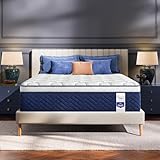
- 1. FP FLEXPEDIC Firm Queen Mattress 12 Inch — Best overall
- 2. Novilla 12 Inch King Size Mattress — Most versatile
- 3. RRESTA Firm Queen Mattress 14 Inch-Hotel Collection — Best for families
- 4. BURFLY1977 King Size Mattress — Best for heavy use
- 5. LoadEase Queen Mattress, 12 Inch Hybrid — Best premium
- 6. HAOREN Full Size Mattress, 10 Inch — Best budget pick
- Does the size on the box match your frame?
- What more money buys across these six
- What the listings don't tell you about shoulder relief
- The verdict
- FAQ
The best box spring for shoulder pain is not a box spring at all: it's the FP FLEXPEDIC Firm Queen Mattress 12 Inch, whose zoned foam softens at the shoulders while 2.1-2.3 mm perimeter coils hold the edges. If you sleep on a king frame, the Novilla 12 Inch King Size Mattress covers 76 inches of width at just 66 lb. Get this wrong and you spend months blaming a foundation for a comfort layer problem.
Best box spring for shoulder pain at a glance
| Pick | Thickness | Shoulder support claim | Price |
|---|---|---|---|
Best overall FP FLEXPEDIC Firm Queen Mattress 12 Inch |
12 in | 7-zone; softer at shoulders/hips (claim) | Check Price |
Most versatile Novilla 12 Inch King Size Mattress |
12 in | SmartS coils cradle pressure points (claim) | Check Price |
Best for families RRESTA Firm Queen Mattress 14 Inch |
14 in | 7-layer zoned system (claim) | Check Price |
Best for heavy use BURFLY1977 King Size Mattress |
12 in | Targeted shoulder/lumbar support (claim) | Check Price |
Best premium LoadEase Queen Mattress 12 Inch Hybrid |
12 in | 800+ pocket coils cradle shoulders (claim) | Check Price |
Best budget pick HAOREN Full Size Mattress 10 Inch |
10 in | Pocket springs, targeted support (claim) | Check Price |




Why a box spring can't fix a sore shoulder
Here's the awkward part. Search for the best box spring for shoulder pain and Amazon returns hybrid mattresses, not foundations. That's not a glitch. It's the market telling you something.
A box spring does one job: it lifts the sleep surface and spreads load across a frame. It sits under everything. Your shoulder never touches it. What touches your shoulder is the top three inches of foam and the coils directly beneath, and that's where every pick on this list does its work.
So treat the modifier honestly. None of these six is a box spring, and none of them can be claimed to cure shoulder pain. What they can do is change how much your shoulder sinks before it meets resistance. Three of the six publish a claim about zoned or targeted shoulder support, and every one of them is the manufacturer's wording rather than a measured result. You still have to judge whether the geometry suits your body.
One useful side note: the Novilla listing states no box spring is needed. All six here are bed-in-a-box hybrids designed to sit on a platform, a slatted frame or the floor. If you were shopping for a foundation because your current one sags, a new sleep surface plus a firm platform is usually the cleaner fix.
How I screened this shortlist down to six
I started from what the category actually returns for this query, then cut on published data rather than marketing tone.
- Real dimensions on the listing. Every pick states thickness, length and width, so you can check it against your frame before you buy. Anything without full dimensions was out.
- Weight published. All six list a shipping weight, from 50 lb to 86.5 lb. That number decides whether you can carry the box alone.
- Hybrid construction. Foam-only beds behave differently at the shoulder. Every pick here pairs pocket springs with foam, which keeps the comparison apples-to-apples.
- A stated firmness or support position. Firm, medium-firm, or a described zoning system. Vague "cloud comfort" copy earned nothing.
- One seller per listing. All six are single-seller listings, which at least means you're buying the configuration described.
What got cut: anything where the thickness was buried in a title but absent from the specifications, and anything sold as a topper rather than a full sleep surface. Toppers are a legitimate route to shoulder comfort, but they're a different purchase with a different failure mode.
I compared the published specifications side by side rather than trusting the headline copy. That's how the FP FLEXPEDIC pulled ahead: it's the only pick that names a specific coil gauge at the perimeter, 2.1-2.3 mm, and it pairs that with a 7-zone layout described as softer at the shoulders. Concrete beats adjectival.
What decides shoulder comfort: thickness or zoning?
Most guides in this category compare thickness. Ten inches, twelve inches, fourteen inches, ranked as if taller always means kinder. That's not what decides it.
Thickness tells you how much total material sits between you and the frame. It says nothing about where that material is soft. A 14-inch bed with a uniformly firm build can push back harder at the shoulder than a 12-inch bed with a deliberately softened shoulder zone. Zoning is the variable that matters, and only some listings describe it.
Here's the practical split across these six:
- Zoned, shoulder named: the FP FLEXPEDIC (7 zones, shoulders and hips softer per the listing), the BURFLY1977 (targeted shoulder and lumbar support per the title), the LoadEase (800+ coils described as cradling shoulders).
- Zoned, lumbar named: the RRESTA, whose listing points its zoned contouring at the lumbar area rather than the shoulder.
- Pressure-point language, no zone map: the Novilla, which describes SmartS coils cradling pressure points.
- General targeted support: the HAOREN, the thinnest at 10 in.
Side sleepers carry the strongest case for zoning. Lie on your side and your shoulder is the widest point of your body, so it needs to sink further than your ribs before your spine straightens out. A surface that resists uniformly holds the shoulder up and bends the neck. Back sleepers face the opposite problem and often prefer the firmer, flatter feel.
That's the real cutoff. Side sleeper: prioritise a named shoulder zone. Back sleeper: prioritise firmness and edge reinforcement instead.
1. FP FLEXPEDIC Firm Queen Mattress 12 Inch — Best overall
The only pick that names a coil gauge and a shoulder-specific zone in the same listing, which is why it leads.
Best for: side sleepers who want zoned shoulder cushioning on a queen frame Skip it if: you need a king, or you're moving the bed upstairs alone
At 12 x 80 x 60 in this is a standard queen, and at 86.5 lb it's the heaviest thing on this list by more than 5 lb. That weight is the tell. More coil and foam mass usually means more material doing the supporting, and it's the reason this one feels substantial rather than springy.
FP FLEXPEDIC describes a 7-zone pocket spring layout with softer cushioning at the shoulders and hips and reinforcement through the lumbar section. It also states reinforced perimeter coils at 2.1-2.3 mm to stop roll-off. That's the most specific engineering figure anywhere in this set, and specificity is worth something when every other listing writes in adjectives. The company also lists an organic cotton cover, gel-infused foam, CertiPUR-US foam and a fiberglass-free build.
It's the fourth-cheapest of the six and sells faster than everything here except the Novilla, so it isn't a niche listing.
The trade-off: it's firm. If you want plush give at the surface, the medium-firm BURFLY1977 is the better temperament, and the 86.5 lb box is genuinely awkward for one person on a staircase.
Pros:
- Only pick naming a perimeter coil gauge, 2.1-2.3 mm
- 7-zone layout with shoulders and hips softened per listing
- Heaviest build here at 86.5 lb, suggesting more material
- Fiberglass-free with CertiPUR-US foam per listing
- Among the faster sellers in this set
Cons:
- Firm feel may hold a broad shoulder too high
- Heaviest box in the set, hard to move alone
- Queen only, so king frames need another pick
- Only one seller lists it
2. Novilla 12 Inch King Size Mattress — Most versatile
The lightest way to cover a full king frame, and the one buyers choose most often here.
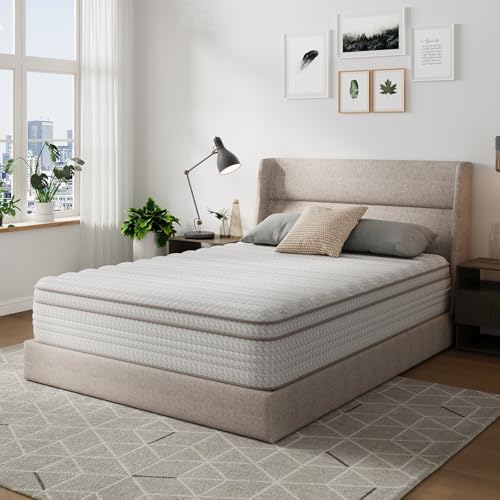
Best for: king-frame sleepers who want the lightest full-width option Skip it if: you want a published firmness level before you commit
Look at the ratio here. 12 x 80 x 76 in of surface at 66 lb, against the BURFLY1977's identical 12 x 80 x 76 in at 80 lb. That's 14 lb less to carry for the same footprint, which matters if you're doing the delivery-to-bedroom leg yourself.
Novilla describes SmartS coils paired with contouring foam to cradle pressure points and promote spinal alignment, plus AirBreeze fabric for airflow and reinforced perimeter support. The foam is listed as CertiPUR-US with an OEKO-TEX cover, and the listing states fiberglass-free. It's also the newest thing here, with a 2026 release date on the specifications, and the title notes no box spring is needed.
It's the second-cheapest of the six and it sells faster than any other pick in this set, which is unusual for a king at that price position.
The trade-off against the FP FLEXPEDIC: Novilla never names a firmness level or a shoulder zone specifically. Its support language points at back relief and general pressure points. If shoulder geometry is your only concern, that vagueness costs it the top spot.
Pros:
- Lightest king here at 66 lb for 76 in of width
- The one buyers choose most often in this set
- Second-cheapest pick despite king sizing
- OEKO-TEX cover and CertiPUR-US foam per listing
Cons:
- No published firmness rating on the listing
- Support claims aim at back rather than shoulder
- Lighter build than rival kings at the same thickness
- Only one seller lists it
3. RRESTA Firm Queen Mattress 14 Inch-Hotel Collection — Best for families
The tallest surface here at 14 inches, with the strongest motion-isolation claim in the set.
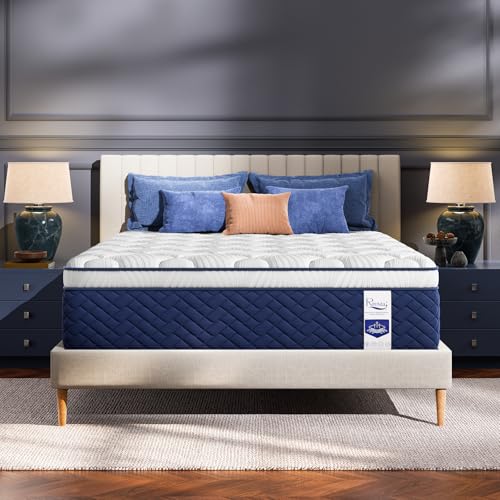
Best for: shared queen beds where one partner wakes easily Skip it if: your sheets are standard-depth or your frame sits high
Fourteen inches is the headline. Every other pick here is 12 in or 10 in, so the RRESTA sits two inches taller than the next-highest and four above the HAOREN. At 14 x 80 x 60 in it's a queen footprint on a hotel-height profile, and at 81.2 lb it's the second-heaviest thing on the list.
RRESTA describes a 7-layer system with a high-gauge coil unit, gel-infused memory foam and zoned contouring. The listing quantifies motion isolation at 90%, which no other pick here attempts to put a number on. It also claims a reinforced steel coil perimeter and CertiPUR-US plus OEKO-TEX certified foams, fiberglass-free.
That 90% figure is why it earns the family pick. If someone gets in and out of bed at odd hours, a surface that absorbs movement is doing real work for the person still asleep.
The catch, and it's a practical one: the zoned language here targets the lumbar zone, not the shoulder. It's also the second most expensive pick in this set. Fourteen inches plus a tall bed frame can put the surface uncomfortably high, and standard fitted sheets will fight you.
Pros:
- Tallest profile in the set at 14 in
- Only pick to state a motion-isolation figure, 90% claim
- Second-heaviest build here at 81.2 lb
- Reinforced steel coil perimeter per listing
Cons:
- Zoned contouring aimed at lumbar, not shoulder
- 14 in needs deep-pocket fitted sheets
- Second most expensive pick in this set
- Only one seller lists it
4. BURFLY1977 King Size Mattress — Best for heavy use
A medium-firm king with shoulder and lumbar support written into the title, not buried in a bullet.

Best for: couples on a king frame who want medium-firm rather than firm Skip it if: you want the option most other buyers have already chosen
This is the substantial king. 12 x 80 x 76 in at 80 lb, which is 14 lb more material than the Novilla at exactly the same dimensions. If two adults share a bed and you've watched a lighter mattress develop a valley down the middle, mass is not a bad thing to buy.
The listing names medium firm rather than firm, and it puts targeted shoulder and lumbar support relief in the title alongside extra edge support. BURFLY1977 describes combining innerspring coils with gel memory foam, multi-layer breathable foam for airflow and moisture wicking, and states certified safe materials. A 365-night trial appears in the title.
Medium-firm is the useful distinction here. Between the firm FP FLEXPEDIC and the firm RRESTA, this is the pick with declared give at the surface, which is generally kinder to a shoulder that needs to sink.
Where it loses: it's by far the slowest seller of the six, so far fewer buyers have chosen it than the Novilla at a similar position. It also sits mid-pack on price with no published coil count or gauge to justify the mass.
Pros:
- Medium-firm rather than firm, kinder to a sinking shoulder
- Heaviest king here at 80 lb for the same 76 in width
- Shoulder support named in the listing title
- 365-night trial stated on the listing
Cons:
- Slowest seller of the six by a wide margin
- No coil count or gauge published
- Heavier to manoeuvre than the Novilla king
- Only one seller lists it
5. LoadEase Queen Mattress, 12 Inch Hybrid — Best premium
The lightest pick in the set at 50 lb, and the only one publishing a coil count.

Best for: solo queen sleepers carrying the box up narrow stairs Skip it if: you're heavier and want more coil and foam mass under you
Fifty pounds. That's 36.5 lb lighter than the FP FLEXPEDIC at identical 12 x 80 x 60 in dimensions, and it's the number that defines this pick. LoadEase leans into it, describing a compressed box built to fit through narrow hallways and tight staircases. If you live in a third-floor walk-up, that difference is your whole afternoon.
It's also the only pick here that gives a coil count: 800+ individually wrapped pocket coils, per the listing. LoadEase describes them working with adaptive memory foam to cradle shoulders, hips and back, with airflow channels through the foam and reinforced edges to prevent roll-off. Medium firm is the stated feel.
The awkward truth is that it's the most expensive pick in this set while being the lightest build. Lower mass at the same thickness generally means less material per inch, and for a heavier sleeper that shows up as faster compression under the shoulder and hip. That's a real risk, not a theoretical one.
Buy it for the logistics and the medium-firm feel, not for durability under load.
Pros:
- Lightest pick in the set at 50 lb
- Only listing publishing a coil count, 800+ claim
- Medium firm with shoulders named in the support claim
- Compact box built for tight stairwells per listing
Cons:
- Most expensive pick here despite the lightest build
- Low mass may compress faster under heavier sleepers
- No firmness zone map published
- Only one seller lists it
6. HAOREN Full Size Mattress, 10 Inch — Best budget pick
The cheapest of the six and the only full size, which makes it the guest-room answer rather than the main bed.

Best for: a full-size guest room or a teenager's bed Skip it if: you sleep on your side and need deep shoulder sink
This is the outlier on every axis, and that's the point. 10 x 75 x 53 in is a full, so it's 7 in narrower and 5 in shorter than the queens here, and its 10 in profile is the thinnest in the set. At 58.3 lb it's the second-lightest box.
HAOREN describes precision-engineered foam layers over responsive pocket springs with reinforced edge support, a breathable knitted cover, and construction aimed at minimising motion transfer and noise. It arrives compressed for easy setup. The support language is general, though: no zone map, no coil gauge, no named shoulder zone.
It's the cheapest pick in this set, and it sells at a healthy clip for the price position.
Ten inches is where I'd pause for shoulder pain specifically. A thinner build has less depth available for a shoulder to sink into before it hits the coil layer, which is exactly the mechanism a side sleeper relies on. For a back sleeper in a spare room, that matters much less.
Pros:
- Cheapest pick in this set
- Only full-size option, fits a 53 in frame
- Second-lightest box at 58.3 lb
- Reinforced edge support per listing
Cons:
- Thinnest profile here at 10 in, least shoulder sink
- No zoned support or coil detail published
- Full size only, no queen or king version
- Only one seller lists it
Does the size on the box match your frame?
Measure first. This is the single most common way this purchase goes wrong, and it costs you a return.
Three sizes appear across these six, and they are not interchangeable:
- Full: HAOREN, 75 x 53 in
- Queen: FP FLEXPEDIC, RRESTA and LoadEase, 80 x 60 in
- King: Novilla and BURFLY1977, 80 x 76 in
Then check the height. Thickness stacks on top of your frame, so a 14 in RRESTA on a tall platform can put the surface above hip height, which makes getting out of bed a small climb. That's the opposite of what you want with a sore shoulder. If your frame already sits high, the 10 in and 12 in picks are the safer geometry.
Sheets are the other trip hazard. Standard fitted sheets are cut for roughly 12 in of depth. The 14 in RRESTA needs deep-pocket sheets, and if you buy the mattress without them, you'll spend a week tucking corners back in every morning.
Last, plan the carry. Weights here run from 50 lb to 86.5 lb, and the box is unwieldy long before it's heavy. Two people and a clear hallway, or the LoadEase at 50 lb if you're on your own.
What more money buys across these six
The pattern across this set is not what you'd expect. Money here does not buy thickness, and it does not buy mass.
At the entry positions sit the HAOREN and the Novilla. The HAOREN is the thinnest at 10 in with the least detailed support description. The Novilla, second-cheapest, is a full 12 in king at 66 lb with certified foams and the fastest sales pace here. That's a lot of surface for a low price position.
In the middle you get the BURFLY1977 and the FP FLEXPEDIC. This is where the specificity arrives. The FP FLEXPEDIC names its zones and its coil gauge; the BURFLY1977 names its firmness and adds 14 lb of mass over the cheaper king. Both are the heaviest builds in the set.
At the premium end, the RRESTA and the LoadEase. The RRESTA converts the money into height, 14 in, and a quantified 90% motion-isolation claim. The LoadEase converts it into the opposite: 50 lb, the lightest build here, sold on portability and a published 800+ coil count.
So the honest read is that the middle of this set is where the shoulder-relevant detail lives. Spending up gets you either a taller bed or a lighter one, depending which end you pick, and neither of those is the same thing as better shoulder support.
What the listings don't tell you about shoulder relief
Every claim above about shoulder support is a manufacturer statement. Not one of these listings publishes an independently measured pressure map, a firmness scale number, or a foam density figure. That gap is worth naming.
Here's what's missing across all six:
- Foam density. Nobody publishes it. Density drives how long a comfort layer resists compression, and a soft, low-density top layer feels wonderful for a month.
- A firmness number. You get words. Firm, medium firm, or nothing at all in the Novilla's case. Two brands' "firm" can be very different surfaces.
- Coil count, mostly. Only the LoadEase gives a figure, 800+, and only the FP FLEXPEDIC gives a gauge, 2.1-2.3 mm at the perimeter.
- Warranty length. Two listings mention a 365-night trial. None of the six publishes a warranty term in its specifications.
Weight is the closest thing to a proxy you have. Compare like for like: two kings at 12 x 80 x 76 in, one at 80 lb and one at 66 lb, and the heavier one has more material inside. That doesn't prove it's better, but it tells you something the marketing copy won't.
And a pillow is worth mentioning. Shoulder discomfort while side sleeping is often a neck-angle problem as much as a surface problem, and no mattress on this list can compensate for a pillow that's too flat.
The verdict
If you sleep on your side on a queen frame and shoulder discomfort is the thing waking you, buy the FP FLEXPEDIC Firm Queen Mattress 12 Inch. It's the only pick in this set that names a shoulder zone and a coil gauge, 2.1-2.3 mm at the perimeter, in the same listing, and its 86.5 lb build is the most material of anything here.
If you're on a king frame, buy the Novilla 12 Inch King Size Mattress. It covers 80 x 76 in at 66 lb, which makes it the easiest king here to get into a bedroom, and it's the one buyers choose most often in this group.
The cutoff between them is simple: frame width. At 60 in you're in queen territory and the FP FLEXPEDIC's zoning wins. At 76 in the FP FLEXPEDIC isn't offered, so the Novilla is the pick.
The Novilla's exact advantage over the winner is weight relative to size. It delivers 16 more inches of width for 20.5 lb less, which is a genuinely different unboxing experience. What it gives up is precision: no firmness rating, no shoulder-specific zoning language. Remember that none of these is a box spring, and none can be claimed to treat shoulder pain. They change how your shoulder is supported. That's all, and it's often enough.
FAQ
Is a box spring or a mattress better for shoulder pain?
A box spring or a mattress? The mattress, without question. A box spring sits under everything and spreads load across the frame, so your shoulder never contacts it. Shoulder comfort comes from the top few inches of foam and the coils immediately beneath. That's why a search for the best box spring for shoulder pain returns hybrid mattresses rather than foundations.
Which is better value, the Novilla or the FP FLEXPEDIC?
Better value between the Novilla and the FP FLEXPEDIC comes down to what you're buying. The Novilla sits at a lower price position and delivers a full king, 80 x 76 in at 66 lb. The FP FLEXPEDIC is a queen at 80 x 60 in and 86.5 lb, with a named 7-zone layout and a 2.1-2.3 mm perimeter coil gauge. More surface versus more published detail.
Is a 14-inch mattress worth it over a 12-inch?
A 14-inch mattress is worth it if you want a hotel-height bed and a low frame to sit it on. The RRESTA at 14 x 80 x 60 in also carries the only quantified motion-isolation claim here, at 90%. Against that, you need deep-pocket sheets, and a tall frame plus 14 in can put the surface awkwardly high.
Do these mattresses need a box spring underneath?
These mattresses don't need a box spring in most setups. The Novilla listing states no box spring is needed, and all six arrive compressed as bed-in-a-box hybrids designed for a platform bed, a slatted frame or the floor. Check your slat spacing before setup, because widely spaced slats can let foam sag between them over time.
What's the biggest mistake buyers make in this category?
The biggest mistake buyers make is treating thickness as a proxy for shoulder comfort. A taller mattress with uniform firmness can hold a broad shoulder higher than a shorter one with a softened shoulder zone. Zoning and firmness matter more than total inches. Measure your frame, check sheet depth, and read the support description rather than the height.
You have two measurements to take before you buy anything here: the width of your frame and the height it already stands at. Those two numbers eliminate four of these six picks in about a minute, which is the fastest useful decision in this whole category. Then pick on firmness language, not thickness. For most side sleepers on a 60-inch frame, the FP FLEXPEDIC is the sensible default, because it's the only listing in this set that bothers to say where the surface gets softer and by how much the edges are reinforced. Specificity is the closest thing to evidence you'll get here.