Best Cervical Pillow for Shoulder Pain: Cozyplayer Wins
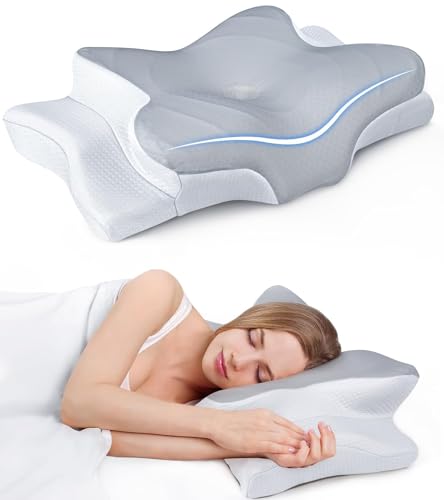
Seven contour pillows, screened on the two numbers that actually decide shoulder comfort: loft height and side-wing width. The winner, the runner-up, and who should skip contour foam entirely.

By Victoria ChapmanUpdated 19 min read
On this page
- Best cervical pillow for shoulder pain at a glance
- How I screened these seven listings
- Why loft height decides this, not firmness
- 1. Cozyplayer Ultra Pain Relief Cooling Pillow for Neck — Best overall
- 2. DONAMA Cervical Pillow for Neck and Shoulder Pain Relief — Most versatile
- 3. Missleep Cervical Neck Pillow — Best for families
- Do armrest wings actually help your shoulder?
- 4. Osteo Cervical Pillow for Neck Pain Relief — Best upgrade
- 5. Royal Therapy Memory Foam Pillow — Best premium
- 6. DONAMA Cervical Pillow for Neck Pain — Best minimal setup
- 7. Polovo Memory Foam Pillows Neck Pillow — Best budget pick
- What the listings do not tell you
- When a different pick wins
- The verdict
- FAQ
The best cervical pillow for shoulder pain is the Cozyplayer Ultra Pain Relief Cooling Pillow, because it pairs a hollow center with adjustable sleep height in a queen-size shell, and height is the single figure that decides whether your shoulder gets crushed. If you sleep hard on one shoulder and want somewhere to put your arm, the DONAMA Cervical Pillow with its 24.8 x 15 in footprint and armrest wings is the better buy. Loft is what splits this field. Everything else is trim.
Best cervical pillow for shoulder pain at a glance
| Pick | Loft heights | Side wings | Price |
|---|---|---|---|
Best overall Cozyplayer Ultra Pain Relief Cooling Pillow |
Adjustable claim, hollow center | Six contour zones claimed | Check Price |
Most versatile DONAMA Cervical Pillow for Neck and Shoulder Pain Relief |
Dual-height claim | Armrest design claimed | Check Price |
Best for families Missleep Cervical Neck Pillow |
3.54 in / 4.72 in | None listed | Check Price |
Best upgrade Osteo Cervical Pillow for Neck Pain Relief |
4.1 in / 5.2 in | Hollow center | Check Price |
Best premium Royal Therapy Memory Foam Pillow |
5 in fixed | None listed | Check Price |
Best minimal setup DONAMA Cervical Pillow for Neck Pain |
2 heights claimed | Widened side wing claimed | Check Price |
Best budget pick Polovo Memory Foam Pillows Neck Pillow |
3.7 in / 5.3 in claim | None listed | Check Price |




How I screened these seven listings
I started with the published specifications, not the marketing sentences. Every pillow here is contoured memory foam sold in the neck and cervical category, and every one is a single-count item, so nobody arrives expecting a pair.
Three screens did the work:
- A published loft figure, or a credible height claim. Four of the seven state actual heights. Missleep gives 3.54 in and 4.72 in. Osteo gives 4.1 in and 5.2 in. Royal Therapy gives a flat 5 in. Polovo claims 3.7 in and 5.3 in in its feature copy.
- A footprint you can check against your bed. Osteo is the widest at 25.5 x 16.5 in. Polovo is the narrowest listed at 23.5 x 13.4 in. That two-inch spread matters more than it sounds when you roll.
- Something specific about shoulder position. Two picks claim armrest or side-wing geometry. Two claim a hollow center. The rest are plain contour shapes.
What got cut in my own head, not from the list: anything where the only differentiator was a temperature claim. Cooling covers show up on five of these seven, described as ice silk, 3D mesh or Arc-Chill fabric. A shared feature is not a deciding one.
One honest note before you read further. This is a set of neck pillows, and the search that produced it treated "shoulder pain" loosely. None of these listings publishes a clinical result for shoulder relief, so treat the shoulder angle as a geometry question you judge yourself: does the loft match your shoulder height, and is there room for your arm?
Why loft height decides this, not firmness
Most guides to the best cervical pillow for shoulder pain compare foam density and firmness. That is the wrong number. Firmness has no published figure on any of these seven listings, so you cannot compare it even if you want to.
Loft height you can compare, because four picks print it.
Here is the mechanism. When you lie on your side, your shoulder is the widest part of your body against the mattress. Your head sits above it. If the pillow is too shallow, your head drops toward the mattress and your neck bends downward, which loads the shoulder joint you are lying on. If the pillow is too tall, your head tips upward and your top shoulder rolls forward.
So the question is arithmetic. Measure from the point of your shoulder to the outside of your neck while lying down. That distance, plus a little for mattress sink, is your target loft.
The spread across this set runs from 3.54 in at the low end of Missleep to 5.3 in at the high end of the Polovo claim. That is not a small range. Broad-shouldered sleepers and deep pillowtop mattresses both push you toward the 5 in end. Slim frames on a firm mattress land nearer 3.5 in.
Three of the seven publish two heights in one pillow, which is the practical hedge if you are guessing. Flip the pillow, sleep a week, flip it back.
1. Cozyplayer Ultra Pain Relief Cooling Pillow for Neck — Best overall
The best cervical pillow for shoulder pain here, because it combines a hollow head well with an adjustable height and it is the fastest seller of the seven.
Best for: side sleepers who need to dial in loft height Skip it if: you want published height figures before buying
Two things separate this from the rest of the set. First, it is the pick buyers choose most often here by a wide margin, and in a category built on trial and error that pattern carries weight. Second, the hollow contour is the design that most directly addresses shoulder loading: your head settles into the recess rather than sitting on top of the foam, which keeps the neck line flatter without adding bulk under your shoulder.
Cozyplayer describes six contour zones shaped to the body's curve, and claims a customizable sleep height built around a 15-degree neck traction angle. Treat both as the manufacturer's description. The cooling cover is claimed as Q-Max 0.4 Arc-Chill fabric that drops skin temperature by 5°C, which is a specific claim and an unverified one.
It comes in queen size, dark grey, one per box. It is the third-cheapest of the seven and sits in the entry group on price, which is the unusual part given it outsells every other pick here.
The trade-off against the rest of this set is documentation. Missleep, Osteo, Royal Therapy and Polovo all give you loft numbers you can measure against your own shoulder. Cozyplayer does not publish one, so the height claim is something you confirm after the box is open.
Pros:
- Fastest-selling pick of the seven
- Hollow center reduces bulk under the shoulder
- Adjustable height claimed for multiple sleep positions
- Entry price position despite topping demand here
- Arc-Chill cooling cover claim, 5°C reduction
Cons:
- No published loft height or weight
- No stated warranty in the listing
- Only one seller stocks it
- Cooling figure is a manufacturer claim, not a standard
2. DONAMA Cervical Pillow for Neck and Shoulder Pain Relief — Most versatile
The one to buy if your bottom arm has nowhere to go, because it is the only pick here with both an armrest design and a stated warranty.

Best for: shoulder-down side sleepers who want an arm channel Skip it if: your bed is narrow and 24.8 in is too wide
This is the most complete listing in the set. You get a 24.8 x 15 in footprint, 2.42 lb of weight, grey colouring, and a 1 Year Warranty, which no other pick here publishes. In a category where returns are common because loft guessing is common, a stated warranty is worth more than another cooling adjective.
DONAMA claims a dual-height design plus armrest sections, hypoallergenic construction, a double-layer stretch cover for hot sleepers, and CertiPUR-US certified slow-rebound foam. The armrest geometry is the part relevant to shoulder discomfort: if you tuck your lower arm under the pillow, you rotate your shoulder forward and load the joint. A dedicated arm channel gives that limb a home at the same level as your head.
It is the second-fastest seller of the seven, behind Cozyplayer, and it sits in the premium group on price at second-most-expensive.
The cost is real estate. At 24.8 in wide with side wings, this occupies more of your bed than the 23.5 in Polovo. On a twin or a shared queen, that width is felt. It also carries a premium price position without publishing the exact loft figures that Missleep and Osteo hand you for less.
Pros:
- Only pick here with a stated 1 Year Warranty
- Armrest sections for the bottom arm
- Full dimensions and 2.42 lb weight published
- CertiPUR-US foam certification claimed
- Second-fastest seller in this set
Cons:
- Wide 24.8 in footprint crowds a shared bed
- Premium price position, exact loft heights unpublished
- Only one seller lists it
- Dual-height figures given as a claim, not a number
3. Missleep Cervical Neck Pillow — Best for families
The clearest specification sheet of the seven, which makes it the safe choice when you are buying more than one.

Best for: a household buying two or three matching pillows Skip it if: you need more than 4.72 in of loft
Missleep publishes the numbers the rest of this set hides: 24.8 x 14.17 x 3.54/4.72 in, 3.21 lb, white, one per box. Those two loft figures are the reason it works for a household. Rotate the pillow 180 degrees and you move between the low and high contour, so one model covers a slim side sleeper and a taller back sleeper without you buying two different products.
It is also the second-cheapest pick here, sitting in the entry group. Buying three of these costs less than buying two of the premium picks, and every one of them behaves identically, which matters when someone swaps sides of the bed.
The listing claims US-patented ergonomic foam, high-density slow-rebound fill with OEKO-TEX, CertiPUR-US and ISPA certifications, and an ice silk cooling cover. It also mentions a warranty in the feature copy without stating a term, so treat that as unspecified rather than confirmed.
The ceiling is the catch. At 4.72 in on its tall side, this is shorter than Osteo's 5.2 in and Royal Therapy's 5 in. Broad-shouldered sleepers on a soft mattress will run out of loft. It also sells more slowly than Cozyplayer and DONAMA here, and the narrower 14.17 in width gives you less room to roll before you fall off the contour.
Pros:
- Two published loft heights, 3.54 in and 4.72 in
- Second-cheapest pick in this set
- Full dimensions and 3.21 lb weight listed
- Three fill certifications claimed
- Flips 180 degrees to change height
Cons:
- 4.72 in ceiling is low for broad shoulders
- Warranty mentioned without a stated term
- 14.17 in width is narrow for rolling
- Only one seller stocks it
Do armrest wings actually help your shoulder?
Two picks here claim them: the DONAMA JK79 and the DONAMA KH1538. Nobody else does. So the question is whether that geometry earns the premium.
The logic holds up. Side sleepers do one of three things with the bottom arm. They tuck it under the pillow, which lifts the head too high and rotates the shoulder. They stretch it straight out under the mattress edge, which compresses the joint. Or they hug it across the chest, which drags the top shoulder forward.
A side wing at the same height as the contour gives that arm a fourth option: resting level, next to your head, with no rotation.
What the listings do not give you is a width figure for the wing. DONAMA describes a "widened side wing" on the KH1538 and an "armrest design" on the JK79. Neither states inches. The JK79's overall 24.8 x 15 in footprint tells you the pillow is broad, and 15 in of depth is the deepest listed here after Osteo's 16.5 in, which suggests the wings are real rather than decorative.
Who should not pay for this:
- Back sleepers, whose arms rest on the mattress anyway
- Anyone on a twin bed, where the width is a liability
- Sleepers who already keep the bottom arm above the pillow
Who should: anyone who wakes with a numb or aching bottom arm rather than a stiff neck. That symptom points to arm position, not head position, and a plain contour pillow will not fix it.
4. Osteo Cervical Pillow for Neck Pain Relief — Best upgrade
The tallest and widest pick here, which makes it the one to reach for when shallower contours leave your neck sagging.
Best for: broad-shouldered sleepers who need maximum loft Skip it if: you sleep on a twin or share a crowded bed
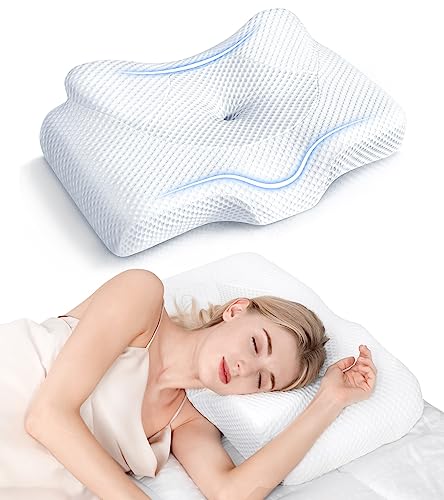
Osteo publishes 25.5 x 16.5 in with 4.1 in and 5.2 in loft options, and it weighs 3.95 lb. That 5.2 in figure is the highest in this set, and the 16.5 in depth is the deepest. Both numbers point the same direction: this is built for a bigger frame lying on a softer mattress, where a 3.5 in pillow disappears into the bedding and your neck ends up folded.
It is the only pick here sold in the specialty medical pillow category rather than general bedding, and the only one with more than one seller listing it. Three sellers stock it, which gives you a fallback that the single-seller picks do not.
Osteo claims a hollow design, a 3D mesh fibre cover for heat escape, no odour, and adjustable height for different sleep styles. The hollow well is the same principle Cozyplayer uses, and on a taller pillow it matters more, because a solid 5.2 in block would push your head forward.
The honest problem is that it sells the slowest of the seven. It also sits in the premium price group while the entry-priced Missleep publishes an equally complete specification sheet. And that 25.5 x 16.5 in footprint is genuinely large. Measure your bed before you commit, because on a twin it will overhang.
Pros:
- Tallest published loft in this set at 5.2 in
- Deepest footprint at 16.5 in for rolling room
- Hollow center plus 3D mesh cover claimed
- Three sellers stock it, unlike most picks here
- Two loft heights, 4.1 in and 5.2 in
Cons:
- Slowest seller of the seven
- 25.5 x 16.5 in is too large for narrow beds
- Premium price position, no stated warranty
- Heaviest pick here at 3.95 lb
5. Royal Therapy Memory Foam Pillow — Best premium
The only fixed-height pillow here, and the lightest by a wide margin at 1.15 lb.

Best for: back sleepers who want a firm 5 in contour Skip it if: you want cooling fabric or a stated warranty
Royal Therapy takes the opposite approach to everything else in this comparison. Where five picks offer two heights or an adjustable claim, this one is a single 24 x 14 x 5 in queen shape. And at 1.15 lb it is by far the lightest here, roughly a third of Osteo's 3.95 lb, which tells you the foam is less dense.
That combination has a real audience. Back sleepers do not need to switch loft, because their shoulder is not under their head. A consistent 5 in contour holds the cervical curve in one position all night, and there is no risk of flipping to the wrong side half-asleep.
The listing claims a three-layer design you can adjust for orthopedic support, and CertiPUR-US memory foam that responds to body temperature. It is described as suitable for side, back and stomach sleepers, though the fixed height makes the back-sleeping case strongest.
This is the most expensive pick of the seven, and that is where it struggles. It gives you no cooling cover claim, which five other picks make. It publishes no warranty term. It offers one loft instead of two. And at 1.15 lb, a heavier sleeper may compress that 5 in down toward 4 in in practice, which the low weight makes plausible. You are paying the most here for the least published capability.
Pros:
- Exact 24 x 14 x 5 in dimensions published
- Lightest pick here at 1.15 lb, easy to move
- Three-layer adjustable construction claimed
- CertiPUR-US foam certification claimed
- Consistent single loft, no wrong-side risk
Cons:
- Most expensive pick in this set
- Single fixed height, no low option
- No cooling cover claim, unlike five other picks
- Low 1.15 lb weight suggests less dense foam
- No stated warranty
6. DONAMA Cervical Pillow for Neck Pain — Best minimal setup
The simplest listing here, offering the same butterfly geometry as its pricier sibling with almost none of the numbers.
Best for: someone replacing a pillow with no fuss Skip it if: you compare specifications before you buy
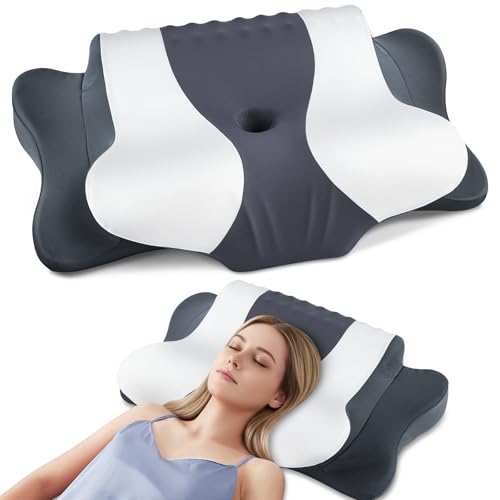
This is DONAMA's second entry and the stripped-back version of the idea. The listing gives you a grey and white colourway, one per box, model KH1538. That is the whole specification sheet. No dimensions, no weight, no warranty term.
What it does claim is the geometry that matters: a hollow butterfly shape supporting head, neck and shoulders, two height bolsters, and a widened side wing for your arms. So structurally it is doing the same job as the JK79 above, with ice-silk double-layer cover fabric and OEKO-TEX certified slow-rebound foam claimed on top.
It sits in the middle on price, the only pick here in that band, which puts it between the three entry picks and the three premium ones. If you have already decided you want a butterfly pillow with arm wings and you do not want to pay premium for it, this is the shortest route.
Two real problems. It is the second-slowest seller of the seven, so fewer buyers have taken this route than the JK79. And the missing dimensions are a genuine risk in a category where loft is the deciding number. You cannot check the height against your shoulder measurement, and you cannot check the width against your bed. Compared with Missleep, which publishes 3.54/4.72 in and 24.8 x 14.17 in for less, this asks you to trust the shape and hope.
Pros:
- Butterfly hollow shape with widened side wing
- Two height bolsters claimed
- Only pick in the middle price group
- Ice-silk cover and OEKO-TEX foam claimed
Cons:
- No published dimensions, weight or loft figures
- Second-slowest seller of the seven
- No stated warranty
- Only one seller lists it
7. Polovo Memory Foam Pillows Neck Pillow — Best budget pick
The cheapest way into contour foam, and the narrowest footprint here at 23.5 in.

Best for: trying contour foam for the first time Skip it if: you have wide shoulders or a deep mattress
Polovo is the cheapest of the seven, and the price is the point. Contour pillows are polarising. Some sleepers adapt in three nights, others never stop feeling the ridge under their neck. Spending the least to find out which you are is a rational move, and this listing gives you a blue and grey colourway with a 23.5 x 13.4 in footprint.
That footprint is the smallest listed here. Two inches narrower than Osteo's 25.5 in, and over an inch shallower than DONAMA's 15 in. On a twin bed, in a bunk, or on a narrow side of a shared queen, small is a feature rather than a compromise.
Polovo claims two heights at 3.7 in and 5.3 in in its feature copy, which is the widest span of any pick here if it holds. It also claims 5-second slow-rebound foam, a washable mesh-sided cover, and a contour shaped to the cervical curve.
Where it falls short is confidence. The height figures live in the marketing bullets rather than the specification list, and the bullets themselves admit a half-inch variation from manual measurement. It sells slowly, third from last in this set. And that 13.4 in depth means less room before you roll off the contour entirely, which is exactly when a pillow stops protecting your shoulder. There is no stated warranty either.
Pros:
- Cheapest pick in this comparison
- Narrowest 23.5 x 13.4 in footprint for small beds
- Widest claimed loft span, 3.7 in to 5.3 in
- Washable cover with mesh side panels
Cons:
- Loft figures appear only in marketing copy
- Listing admits half-inch measurement variation
- 13.4 in depth gives little room to roll
- No stated warranty, single seller
What the listings do not tell you
Four gaps run through every one of these seven listings, and knowing them changes how you shop.
- Nobody publishes firmness. Not one of these seven states an ILD figure or a density number. Weight is the only proxy you get, and it ranges from 1.15 lb on Royal Therapy to 3.95 lb on Osteo. Heavier usually means denser foam and less compression under your head, but that inference is yours, not the manufacturer's.
- Break-in time is never mentioned. Slow-rebound foam feels firm on night one and softer by night ten. If your shoulder aches more after two nights, that is not necessarily the wrong pillow.
- Certifications describe the foam, not the design. OEKO-TEX, CertiPUR-US and ISPA cover emissions and content. They say nothing about whether the contour suits your body.
- Shoulder relief is never quantified. Several of these titles name shoulder pain. None publishes a measured outcome. The mechanism is plausible geometry, and that is the honest level of claim.
Three of the seven publish complete dimension sets: Missleep, Osteo and Royal Therapy. Two publish almost nothing beyond colour and model, DONAMA's KH1538 and Cozyplayer. If you are the kind of shopper who measures before buying, that split should steer you.
When a different pick wins
The winner is the default, not the answer for everyone. Here is where it flips.
- If your shoulder-to-neck measurement exceeds 5 in, buy the Osteo at 5.2 in. Missleep's 4.72 in ceiling and Royal Therapy's 5 in will both leave your neck sagging downward.
- If your bottom arm goes numb before your neck gets stiff, buy the DONAMA JK79. That symptom is arm position, and only the two DONAMA picks claim an arm channel.
- If your bed is under 25 in of usable pillow width, buy the Polovo at 23.5 x 13.4 in. Osteo's 25.5 x 16.5 in footprint will overhang.
- If you sleep on your back only, buy the Royal Therapy. A fixed 5 in contour is a feature when your shoulder is not in the equation, and 1.15 lb is easy to reposition.
- If you are buying two or more, buy Missleep. It publishes both loft figures, sits in the entry price group, and flips 180 degrees so two sleepers can share one model.
The threshold that governs most of these is 5 in of loft. Below it, the entry picks cover you. At or above it, only Osteo and Royal Therapy qualify, and only Osteo pairs that height with a hollow well.
The verdict
The Cozyplayer Ultra Pain Relief Cooling Pillow is the best cervical pillow for shoulder pain for most people, because the hollow center and adjustable height address the actual mechanism: keeping your head level without stacking foam under the shoulder you are lying on. It also outsells every other pick in this set while sitting in the entry price group, which is a rare combination. That popularity matters in a category where fit is personal and most buyers arrive after returning something else.
Two conditions flip that recommendation. First, if you wake with a numb or aching bottom arm rather than a stiff neck, the DONAMA JK79 is the better buy. It is the only pick here pairing an armrest design with a published 1 Year Warranty, and 24.8 x 15 in gives that arm somewhere real to sit. Second, if your shoulder measurement puts you above 5 in of loft, the Osteo wins on the strength of its 5.2 in high side, which no other pick here matches.
The runner-up's precise advantage is documentation plus geometry. DONAMA publishes dimensions, weight and a warranty term, and it is the only premium pick that does all three. Cozyplayer beats it on demand and price position, not on paperwork.
FAQ
Is a cervical pillow worth it for shoulder pain?
A cervical pillow is worth it for shoulder pain when your discomfort comes from head position rather than the joint itself. The contour holds your head level with your shoulder instead of letting it drop, which reduces the sideways load on the joint you sleep on. None of these seven listings publishes a measured clinical result, so treat it as a geometry fix you test yourself.
What height cervical pillow do I need for wide shoulders?
The height cervical pillow buyers with wide shoulders need usually sits at the top of the available range. In this set that means Osteo's 5.2 in side or Royal Therapy's fixed 5 in. Measure from the point of your shoulder to the outside of your neck while lying on your side, then add a little for mattress sink. Missleep's 4.72 in ceiling will feel short.
Which is better, the Cozyplayer or the DONAMA JK79?
Between the Cozyplayer and the DONAMA JK79, choose by symptom. Cozyplayer wins on price position and demand, with a hollow center for head sinkage. DONAMA JK79 wins on documentation, publishing 24.8 x 15 in, 2.42 lb and a 1 Year Warranty, plus armrest sections. Numb bottom arm points to DONAMA. Stiff neck alone points to Cozyplayer.
Can I get a good cervical pillow for shoulder pain without spending much?
You can get a good cervical pillow for shoulder pain from the entry group here. Polovo is the cheapest, with a compact 23.5 x 13.4 in footprint. Missleep is second-cheapest and publishes 3.54 in and 4.72 in loft heights plus 3.21 lb of weight. Cozyplayer also sits in the entry group despite outselling every premium pick in this comparison.
What is the biggest mistake when buying a contour pillow?
The biggest mistake when buying a contour pillow is judging it on night one. Slow-rebound foam feels firmer at first and softens over roughly a week as it responds to body heat. The second mistake is guessing at loft. Three picks here publish two heights precisely so you can flip and reassess rather than commit to one guess.
Start by measuring your shoulder-to-neck distance lying on your side, before you look at another listing. That single figure eliminates most of this field for you and turns a guessing game into a shortlist of two. Once you have it, the Cozyplayer is the sensible default because the hollow center forgives a small measurement error in a way a solid contour does not, and it costs less than three of the six alternatives here. Give whichever you pick a full week before you judge it. Foam that feels wrong on Tuesday often feels right by Sunday.