Best Metal Raised Garden Beds by Depth and Volume
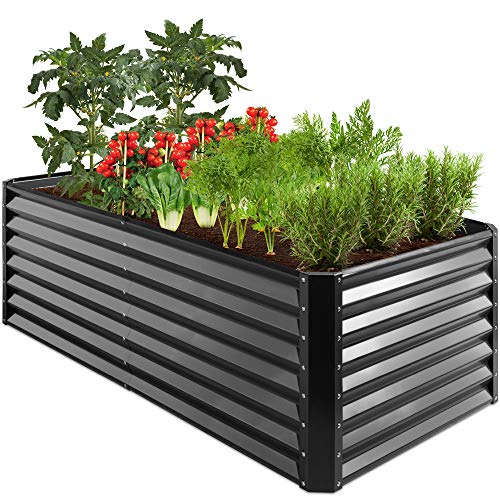
Five metal raised garden beds compared by depth, footprint and soil volume, with a clear winner for deep-root crops and a budget pick for small plots.

By Victoria ChapmanUpdated 13 min read
On this page
- Best electric metal raised garden bed at a glance
- A note on the word electric
- How I cut a longer list down to five
- 1. Best Choice Products 6x3x2ft — Best overall
- 2. SnugNiture 3 Pcs 4x2x1.5ft — Runner-up
- 3. Land Guard Galvanized Raised Garden Bed Kit — Best budget pick
- 4. Land Guard 2 Pack 6×3×2 ft — Best for beginners
- 5. Best Choice Products 8x2x2ft — Best premium
- What actually decides a raised bed purchase
- How deep does a raised bed really need to be?
- What more money buys across this set
- How much soil will you actually need?
- The verdict
- FAQ
The best electric metal raised garden bed in this shortlist is the Best Choice Products 6x3x2ft, because 24 inches of depth and a stated 269-gallon capacity give deep-rooted crops room the shallower beds here cannot match. If you would rather spread the same footprint across three separate planters, the SnugNiture 3-pack at 17 inches tall is the alternate pick. Ignore a bed with less than 12 inches of soil for anything beyond lettuce: root binding is the failure mode that kills a first garden.
Best electric metal raised garden bed at a glance
| Pick | Depth | Footprint | Price |
|---|---|---|---|
Best overall Best Choice Products 6x3x2ft |
24 in 269 gal claim |
6 x 3 ft single bed |
Check Price |
Runner-up SnugNiture 3 Pcs 4x2x1.5ft |
17 in | 4 x 2 ft three beds |
Check Price |
Best budget pick Land Guard 4x2x1ft |
12 in | 4 x 2 ft single bed |
Check Price |
Best for beginners Land Guard 2 Pack 6x3x2ft |
24 in 249 gal claim |
6 x 3 ft two beds |
Check Price |
Best premium Best Choice Products 8x2x2ft |
24 in 215 gal claim |
8 x 2 ft single bed |
Check Price |


A note on the word electric
You searched for the best electric metal raised garden bed, so let's clear this up before the picks. None of the five beds here run on power. There are no heating cables, no grow lights, no irrigation pumps in these listings. Amazon returned metal raised beds because that's what actually sells at scale in this category, and no mainstream manufacturer bundles heating with a steel planter box.
If your plan involves seedling heat mats, drip irrigation timers or under-bed soil warmers, treat those as separate purchases and pick the bed on its own merits: depth, footprint, steel gauge and how it sits in your plot. Every pick below is a passive planter. That's the honest read of what this search returns.
How I cut a longer list down to five
Three filters shaped this shortlist, applied in order.
- Anything under 12 inches deep got cut. Salad greens tolerate shallow soil; almost nothing else does. A 6-inch bed is a decorative trough, not a vegetable garden.
- Beds without a stated steel treatment got cut. Galvanized or powder-coated finishes are what keep a metal bed from rusting through in three seasons. Bare mild steel is a false economy.
- Beds that failed to publish a footprint got cut. You cannot plan a plot around a listing that skips the length and width.
What survived splits neatly into two shapes: tall single beds at 24 inches of depth, and lower multi-bed kits at 12 to 17 inches. That's the real fork in this category, and it's what decides your buy more than brand or colour.
Two of the five come from Best Choice Products, two from Land Guard, one from SnugNiture. The Land Guard 4x2x1ft is the one buyers choose most often here by a wide margin, and the Best Choice Products 8x2x2ft is the slowest seller of the five. Both facts matter less than whether the bed fits your plot.
1. Best Choice Products 6x3x2ft — Best overall
The 24-inch depth and 269-gallon soil capacity make this the pick when deep-rooted crops are the point of the garden.
Best for: deep-root crops in a single large plot Skip it if: you want more than one bed for the same outlay
Two feet of soil is what separates a real vegetable bed from a herb trough. The Best Choice Products 6x3x2ft delivers that depth across a 6-by-3-foot footprint, giving you 36 cubic feet of growing volume in a single unit. Best Choice says the powder-coated steel panels come with rubber edging and a set of wingnuts for tool-free assembly, and that the kit ships with four ground stakes and two stabilising rods to keep a bed this tall from bowing under wet soil. The listing rates the materials as FHSA-compliant and screened against PFAS and California Proposition 65, which is unusual detail at this price position.
The trade-off is footprint choice: you get one bed, not two or three, so a rectangular plot is the assumption. It's the most expensive single-bed pick here, but the only single unit at this depth without stepping up to the 8-foot Best Choice model. There is no bottom panel, per the listing.
Pros:
- 24-inch depth for tap-rooted crops
- 269-gallon stated capacity
- Ground stakes and stabilising rods included
- Powder-coated steel with rubber edging
- Non-toxic material claims documented
Cons:
- One bed only at this price position
- No bottom panel included
- Heavier at 35 lb than the shorter kits
2. SnugNiture 3 Pcs 4x2x1.5ft — Runner-up
Three separate 17-inch-tall beds in a single buy, for gardeners who want to split crops across zones.

Best for: gardeners who want three separate beds in one buy Skip it if: you need 24 inches of soil depth for tap-rooted crops
The SnugNiture kit is the only one here that ships three beds, each 46 by 23.6 inches with 17 inches of depth. That's the reason to pick it. Three separate boxes let you keep tomatoes away from brassicas, run a rotation without digging out the same bed, or space beds along a path with proper walking room between them. SnugNiture calls out an oval structure it says resists deformation better than a flat-sided rectangle, and rubber safety edging along the top rim. The galvanized finish handles rain that would rust bare steel.
The height is the compromise. Seventeen inches is enough for lettuce, herbs, bush beans, strawberries and most peppers, but a serious carrot or parsnip crop wants more. It's the mid price position of the five, which is the second-cheapest way here to get more than one bed. If your plot suits three medium beds better than one deep one, this is the smarter buy than the winner.
Pros:
- Three separate beds in one purchase
- 17-inch depth handles most vegetables
- Oval structure resistant to bowing
- Rubber safety edging on rims
- Galvanized rust protection
Cons:
- Shallower than the 24-inch picks
- No stated weight in the listing
- No published warranty term
3. Land Guard Galvanized Raised Garden Bed Kit — Best budget pick
A single 4x2x1ft oval bed at the lowest price position here, and the one buyers choose most often in this set.
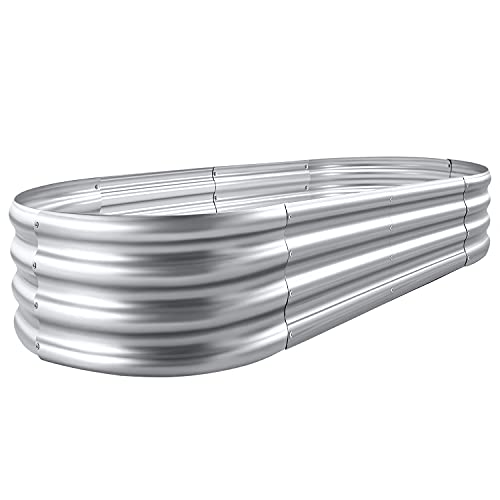
Best for: a first raised bed on a small patio or balcony Skip it if: you want to grow carrots, parsnips or deep-rooted tomatoes
The Land Guard 4x2x1ft is the entry point to metal raised beds. One foot of depth, a 4-by-2-foot footprint, 5 lb of steel to lift out of the box. Land Guard states the panel is Q195 galvanized sheet with double-layer anti-corrosion galvanizing, and that the average thickness is 0.78mm with a thickest section at 1.56mm. That's more spec detail than most beds at this position bother to publish. The oval structure is the same shape SnugNiture uses, and the open base drains freely into whatever sits below it.
Twelve inches of soil is the honest limit. Herbs, lettuce, radishes, strawberries and bush beans do fine. Deep-rooted crops will hit the ground beneath and either escape or stunt. This bed sells faster than every other pick here by a clear margin, which tells you what most first-time buyers actually want: a small, cheap, tidy planter. It is the cheapest of the five, and it is the shallowest.
Pros:
- Cheapest of the five
- Double-layer galvanized coating
- Panel thickness published
- 5 lb assembly weight
- Fits small patios and balconies
Cons:
- 12 inches of depth is the floor for real vegetables
- One bed only
- No ground stakes mentioned
4. Land Guard 2 Pack 6×3×2 ft — Best for beginners
Two full-size 24-inch-deep beds for less than the single premium picks, if you have the space for both.

Best for: someone building two matching beds in one weekend Skip it if: you have room for only one bed in the yard
If you know from the start that one bed will not be enough, the Land Guard two-pack changes the maths. You get two 6-by-3-foot beds, each 24 inches deep, with a combined weight of 48 lb across the kit. Land Guard puts the growing volume of each 6x3x2ft bed at 36 cubic feet and 249 gallons. The galvanized coated steel is the same treatment the brand uses on its single bed, and the open bottomless base lets deep roots push into the ground below rather than pooling water inside the panels.
The catch is you need the plot for two of them. Two 6x3 beds want roughly 36 square feet of clear ground plus walking space, which is a real chunk of a suburban yard. Assembly time is doubled. Only one seller lists the kit, so if that seller runs out, the listing is dark. It is the second-cheapest position here, which is the real hook: two 24-inch beds cost less than the single winner.
Pros:
- Two 24-inch beds in one buy
- 249-gallon stated capacity each
- Galvanized coated steel
- Bottomless base for drainage
- Second-cheapest position here
Cons:
- Only one seller lists the kit
- Assembly doubles for two beds
- Needs 36 square feet of clear ground
5. Best Choice Products 8x2x2ft — Best premium
An 8-foot-long, 24-inch-deep bed in a narrow 2-foot width, sized for a fence line or path edge.

Best for: a long, narrow strip along a fence or path Skip it if: your plot is squarer than it is long
Length is what this bed sells. Eight feet by two feet by two feet deep gives you 215 gallons of stated capacity in a shape that hugs a boundary. You can reach the middle from either side without stepping in, which the listing calls out as an easy-reach benefit for older gardeners or anyone who dislikes bending. Best Choice says the modular design allows one of six configurations from the same panel set, using 8 curved panels and 16 straight ones. The powder-coated steel and beveled edges match the winner, with the same rubber edging on the rims.
It is the most expensive pick here and the slowest seller of the five, which reads less as a quality signal and more as a footprint that suits a narrower slice of gardens. If you have a squarer plot, the 6x3x2ft winner uses your ground more efficiently. If you have a fence to line, nothing else here fits the shape. Only one seller lists it. There is no bottom panel.
Pros:
- 8-foot length for boundary planting
- 24-inch depth for deep roots
- Modular panel set with multiple layouts
- Powder-coated steel with rubber edging
- Easy-reach 2-foot width
Cons:
- Most expensive pick here
- Slowest seller of the five
- Only one seller lists it
- No bottom panel
What actually decides a raised bed purchase
Depth decides more than any other spec. A bed under 12 inches deep is a salad and herb planter. A bed at 17 inches handles most of what a home garden grows. A bed at 24 inches handles everything, including carrots, parsnips, indeterminate tomatoes and long-rooted brassicas.
Footprint decides second. Length and width together set what you can plant, and how many crop families you can rotate through the same bed across a season. A single 6-by-3-foot bed gives you 18 square feet. Three 4-by-2-foot beds give you 24 square feet split three ways.
Steel treatment decides third. Powder-coated and galvanized finishes both resist rust for years; bare mild steel does not. Both winners here use one or the other.
Brand, colour and the shape of the corners decide very little. Do not let a listing photo make the call.
How deep does a raised bed really need to be?
Here's the trick with depth: it is not just about root length, it is about how much soil moderates temperature and moisture around those roots. A shallow bed dries out and overheats faster because there is less thermal mass. Twenty-four inches of soil holds moisture through a hot afternoon in a way that twelve inches cannot.
Rule of thumb by crop:
- 6 to 8 inches: lettuce, spinach, radishes, most herbs
- 12 inches: bush beans, peppers, strawberries, garlic, most brassicas
- 18 inches: tomatoes, cucumbers, squash, kale, chard
- 24 inches: carrots, parsnips, potatoes, indeterminate tomatoes, deep-rooted perennials
The three 24-inch beds here cover every row of that list. The 17-inch SnugNiture covers everything down to and including kale comfortably. The 12-inch Land Guard covers the first two rows.
What more money buys across this set
Move up from the cheapest pick to the most expensive and here is what the spend actually gets you.
- More soil depth. The entry pick sits at 12 inches. The mid pick sits at 17. The three top picks all sit at 24.
- More footprint. Length and width scale with the position, from 4 by 2 feet at the entry to 8 by 2 feet at the top.
- More kit in the box. The two Best Choice Products picks include ground stakes, stabilising rods and rubber edging as standard. The Land Guard single bed includes fewer accessories, per the listing.
- Documentation. The winner is the only one in this set with published FHSA compliance and PFAS screening notes.
What you do not get, at any position here: a bottom panel, a warranty term stated in the listing, or bundled soil.
How much soil will you actually need?
Soil volume is the shock most first-time buyers do not budget for. The winner holds a stated 269 gallons; the two-pack Land Guard beds hold a stated 249 gallons each; the 8-foot Best Choice premium bed holds 215 gallons.
In cubic yards, roughly:
- 269 gallons ≈ 1.3 cubic yards
- 249 gallons ≈ 1.2 cubic yards
- 215 gallons ≈ 1.1 cubic yards
Bagged soil sold at big-box stores runs at about 1.5 cubic feet per bag. A single 24-inch-deep 6x3 bed swallows twenty-plus of those bags. Bulk soil delivered by the yard is far cheaper for anything at this depth, and most people who buy a tall bed underestimate the fill by half. Plan the soil order before the bed arrives, not after.
The verdict
If your plot has room for one bed and you want to grow a real vegetable garden, the Best Choice Products 6x3x2ft is the pick. Twenty-four inches of depth, a 269-gallon stated capacity, and the most detailed material documentation in this set make it the safest single-bed choice for anyone growing beyond salad greens.
If your plot has room for two beds and you would rather spend the same money on capacity than on documentation, the Land Guard 2 Pack 6x3x2 ft is the two-track alternative. You get two 24-inch beds at the second-cheapest position here, and each one matches the winner's depth. The cutoff is space: below 36 square feet of clear ground plus walking room, take the single winner; above it, take the two-pack.
The premium 8-foot Best Choice bed is a shape-specific pick, not a general upgrade over the winner. Choose it only if you have a fence line or a path edge that suits an 8-by-2-foot strip. The SnugNiture three-pack is the answer when depth matters less than having separate zones. The Land Guard single is the honest entry point for a first bed on a small patio.
FAQ
Is a metal raised garden bed worth it over wood?
A metal raised garden bed is worth it if you value a decade-plus service life without staining, sanding or replacing rotted boards. Galvanized and powder-coated steel resist rain and soil moisture in a way cedar and pine cannot match past three or four seasons. The trade-off is soil temperature: metal panels warm faster in direct sun, which helps early spring and hurts high summer.
How deep should a raised garden bed be for tomatoes?
How deep should a raised bed be for tomatoes depends on the variety. Determinate bush tomatoes do fine in 12 to 18 inches of soil. Indeterminate vining tomatoes want the full 24 inches, because their root systems keep pushing down through the season. Three of the picks here hit that 24-inch mark: the winner, the two-pack Land Guard, and the 8-foot Best Choice premium.
Does the Land Guard budget pick fit on a balcony?
Does the Land Guard budget pick fit on a balcony? Yes, at 48 inches long by 24 inches wide and 12 inches tall, it sits comfortably on most standard balconies with room for a chair beside it. The 5 lb assembled weight is the lightest here. Check your balcony's load rating once soil goes in: wet soil at that footprint adds significant weight.
Best Choice Products 6x3x2ft or Land Guard 2 Pack: which wins?
Best Choice Products 6x3x2ft or Land Guard 2 Pack comes down to whether you need one bed or two. The Best Choice winner ships one bed with fuller documentation, ground stakes and stabilising rods. The Land Guard two-pack ships two beds at a lower combined position with fewer stated accessories. Same 24-inch depth on both. Different answers to different plot sizes.
What is the biggest mistake first-time raised-bed buyers make?
The biggest mistake first-time buyers make is picking a bed too shallow for the crops they actually want to grow. A 6-inch or 8-inch bed cannot support tomatoes, carrots or squash no matter how carefully you water it. The second mistake is underestimating soil volume. A 24-inch-deep bed at 6 by 3 feet swallows more than a cubic yard of fill.
Whichever bed you choose, order the soil before the box arrives, level the ground with a rake, and set the bed on cardboard to smother grass underneath. The Best Choice Products 6x3x2ft is the default for a reason: 24 inches of depth is the single spec that decides whether a first vegetable garden works or fails, and it is the deepest bed here in a single unit with the fullest published material documentation. Everything else on this list is a variation on footprint and plot shape. Start with depth, plan the soil, then buy the bed.