Best Latex Pillow for Shoulder Pain With Side Sleeping

Five pillows compared on loft, adjustability and fill, with the one adjustable latex pick that suits shoulder-heavy side sleeping and four alternatives when it doesn't fit your frame.

By Victoria ChapmanUpdated 15 min read
On this page
- Best latex pillow for shoulder pain at a glance
- How the five picks were weighed against each other
- Why loft height decides shoulder comfort, not fill
- 1. TalatexHome TALATEX 100% Natural Premium Latex Pillow — Best overall
- 2. Cozyplayer Ultra Pain Relief Cooling Pillow for Neck — Best upgrade
- 3. ORHETVE Talalay Latex Pillow — Best minimal setup
- 4. Kiss Dream 100% Natural Talalay Latex Pillow Sleeping Bed — Best for pros
- 5. Missleep Cervical Neck Pillow — Best budget pick
- Latex or memory foam for the best latex pillow for shoulder pain?
- What the listings don't tell you about shoulder pain
- When a different pick wins
- The verdict
- FAQ
The best latex pillow for shoulder pain is the TalatexHome TALATEX 100% Natural Premium Latex Pillow, because its removable 2cm cushion lets you drop loft in stages until your shoulder stops carrying the load. If you'd rather have a moulded contour shape than shredded latex, the Cozyplayer Ultra Pain Relief Cooling Pillow is the alternative, and it's the second-cheapest of the five here.
Price tiers in this category map onto capability unevenly. The entry picks buy you memory foam with two fixed loft settings. The premium picks buy you natural latex, published dimensions and, in one case, a height insert you can remove. The middle buys softness.
Best latex pillow for shoulder pain at a glance
| Pick | Loft / height | Fill | Price |
|---|---|---|---|
| Adjustable, 2cm insert removes | Shredded natural latex | Check Price | |
| Adjustable, 6 contour zones claim | Memory foam | Check Price | |
Best minimal setup ORHETVE Talalay Latex Pillow |
6.2 in fixed | Talalay latex | Check Price |
Best for pros Kiss Dream 100% Natural Talalay Latex Pillow |
6.2 in fixed, extra soft | Natural Talalay latex | Check Price |
Best budget pick Missleep Cervical Neck Pillow |
3.54 in / 4.72 in, flip to switch | Memory foam | Check Price |

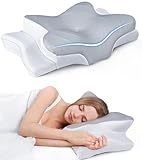


How the five picks were weighed against each other
Three criteria did the sorting here, in this order of weight.
- Loft control, weighted heaviest. A pillow you can lower is a pillow that can be made right. Two of the five let you change height: the TalatexHome pillow via a removable 2cm cushion, the Missleep via a 3.54 in and 4.72 in contour on opposite edges. Cozyplayer claims customisable height too, without publishing the figures.
- Published dimensions, weighted second. You cannot judge shoulder fit from adjectives. Three listings publish a loft figure. ORHETVE gives 6.2 x 27.5 x 15.7 in, Missleep gives 24.8 x 14.17 in with both contour heights, and Kiss Dream's feature copy states 23.6 x 15.7 x 6.2 in even though its dimension field doesn't repeat it.
- Fill honesty, weighted third. Two picks are memory foam, not latex, and I've labelled them plainly rather than quietly folding them in. Three are latex, and two of those specify Talalay.
Those weights come from the failure mode. Shoulder discomfort at the pillow is usually a geometry problem, so a pillow with a knob to turn beats a pillow with a better material spec. Everything else — cooling covers, ventilation holes, contour zone counts — sits below those three and broke no ties.
Why loft height decides shoulder comfort, not fill
Most guides to the best latex pillow for shoulder pain compare latex against memory foam. That's the wrong argument. The number that matters is loft, the vertical gap between mattress and pillow surface.
Here's the mechanism. On your side, your shoulder is the widest part of your frame touching the bed. A pillow too shallow lets your head sag toward the mattress, and the shoulder gets crushed into the gap. A pillow too tall props your head up, and the shoulder gets pulled forward and up.
So the useful spec is a range, not a material. Look at what these five publish:
- Missleep: 3.54 in on one edge, 4.72 in on the other
- ORHETVE: 6.2 in, fixed
- Kiss Dream: 6.2 in per its feature copy, described as extra soft
- TalatexHome: adjustable via a removable 2cm cushion
- Cozyplayer: adjustable, no figure published
That's a spread of nearly 3 in between the shallowest and the tallest option here. Nearly 3 in is enormous at the shoulder. It's the difference between a pillow that works and a pillow you give away.
Fill type still matters, but for a second-order reason. Latex resists compression, so a 6.2 in latex pillow stays close to 6.2 in under load. Memory foam softens with body heat and settles. A firm pillow that holds its number is easier to plan around than a soft one that changes.
1. TalatexHome TALATEX 100% Natural Premium Latex Pillow — Best overall
The only pick here that combines natural latex with a physically removable height insert, which is the combination that lets you tune shoulder clearance without buying twice.
Best for: side and back sleepers who need to dial loft down in stages Skip it if: you want a solid moulded core rather than shredded latex
TalatexHome lists this as Standard, 23.6 x 15.7 in, with a shipped dimension of 28 x 15.7 in. The stated firmness is medium. What separates it from the other two latex picks is the removable 2cm cushion, which the brand describes as a way to customise height for side and back sleepers. Neither ORHETVE nor Kiss Dream offers that; both are fixed at 6.2 in.
The core is shredded latex rather than a single moulded block, which the listing says is sourced from Thailand and contains no synthetic fibres. TalatexHome also claims a ventilation hole system for airflow and says the medium-firm core contours without sinking. Treat both as manufacturer claims.
The trade-off against the rest of the set is cost and popularity. This is the second-most expensive of the five, only one seller lists it, and it's the slowest seller here by a wide margin. Both entry-priced memory foam picks move faster. You're paying a premium for natural latex plus adjustability, and you don't get a published loft figure at either setting, which means the first two nights are trial and error.
Pros:
- Removable 2cm cushion adjusts loft in stages
- Only adjustable latex option in this set
- 100% natural latex core, no synthetic fibres
- Ventilation hole system claim for airflow
- Medium firmness suits side and back sleeping
Cons:
- No published loft figure at either height setting
- Second-highest price position of the five
- Shredded core rather than a solid moulded block
- Slowest seller in this group
- No stated warranty in the listing
2. Cozyplayer Ultra Pain Relief Cooling Pillow for Neck — Best upgrade
Memory foam rather than latex, but it's the pick buyers here choose most often and it sits in the entry price tier while claiming adjustable height.
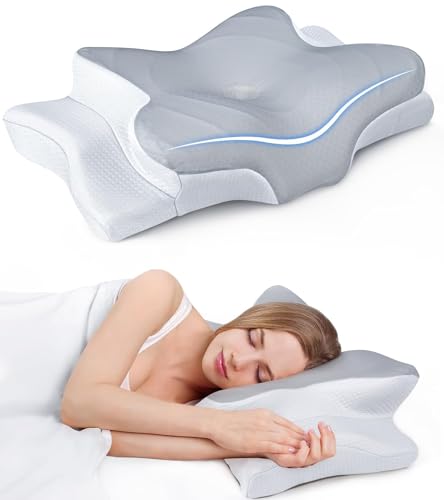
Best for: side, back and stomach switchers who want a contoured shape Skip it if: you specifically want natural latex
Two things put this second. It sells faster than every other pick here, and it's the second-cheapest of the five while still claiming height customisation. That's an unusual pairing in this category, where adjustability normally costs.
Cozyplayer lists it in Queen, Dark Grey, single count, and describes six contour zones shaped around the body's curves plus a hollow section that combines a flat bed pillow with a contour pillow. The cover is claimed to be Q-Max 0.4 Arc-Chill fabric that drops skin temperature by 5°C, and the brand references a 15° neck traction angle during sleep. All of that is listing copy, not a measured result.
The honest problem is disclosure. No loft figure, no weight, no dimensions, and no warranty appear in the specifications. For a category where loft is the deciding number, that's a real gap, and it's the reason a latex pick with published inches ranks above it despite selling less. It's also memory foam, so if you came here specifically for latex it isn't your pillow.
Pros:
- The pick buyers choose most often in this set
- Second-cheapest of the five
- Six contour zones claimed for body curvature
- Arc-Chill cooling cover claim
- Queen sizing, single-pillow count
Cons:
- Memory foam, not latex
- No loft, weight or dimension figures published
- No stated warranty
- Cooling and traction figures are unverified brand claims
3. ORHETVE Talalay Latex Pillow — Best minimal setup
The most completely specified pillow here: 6.2 x 27.5 x 15.7 in, 2.8 lb, Talalay latex, nothing to assemble or flip.

Best for: queen-bed sleepers who want a fixed 6.2 in loft and no fiddling Skip it if: your shoulders need a shallower pillow than 6.2 in
If you already know your loft, this is the cleanest buy in the group. ORHETVE publishes the full set: Queen at 6.2 x 27.5 x 15.7 in, 2.8 lb, White, model ORH01, with a removable cotton inner cover. It's Talalay latex, which is the pin-cored, whipped-and-baked version of latex rather than the denser Dunlop process.
The listing states three sizes, Standard at 23.6 x 15.7 x 6.2 in, Queen at 27.5 x 15.7 x 6.2 in and King at 33.4 x 15.7 x 7 in, and offers soft, medium or firm firmness. The version specced here is Mid Loft. ORHETVE claims a perforated ventilation system to prevent overheating and a bounce-back structure that holds shape across back, side and stomach positions.
Its weakness is the flip side of its virtue. There's no adjustment whatsoever, so 6.2 in is what you get, and 6.2 in is a lot of pillow for a narrow-shouldered side sleeper. At 2.8 lb it's also the heaviest latex pick here, which makes repositioning it mid-night more of a lift than the 2.2 lb Kiss Dream. It's the second-most expensive tier alongside the winner, with no adjustability to show for it.
Pros:
- Most fully specified listing in this set: loft, weight, dimensions, model
- Talalay latex with perforated ventilation
- Removable cotton inner cover
- Three sizes published, up to 33.4 in King
- Firmness options include soft, medium and firm
Cons:
- Fixed 6.2 in loft, no adjustment at all
- Heaviest latex pick here at 2.8 lb
- Premium price position without adjustability
- No stated warranty
- Only one seller lists it
4. Kiss Dream 100% Natural Talalay Latex Pillow Sleeping Bed — Best for pros
The only pick in this set with a published warranty, and the lightest at 2.2 lb, sold in an extra soft firmness.

Best for: lighter-framed sleepers who bottom out firm pillows Skip it if: you have broad shoulders and need real resistance
One spec makes this worth knowing about: a one year warranty, which no other listing in this group publishes. That's the kind of detail that separates a brand willing to stand behind a product from four that stay quiet.
Kiss Dream lists it in Standard, Extra Soft, Ivory, 2.2 lb, model KD06, with a shipped dimension of 27.5 x 15.7 in. The core is stated as 100% natural latex with a 100% cotton outer cover. The feature copy gives 23.6 x 15.7 x 6.2 in and calls it low profile, ideal for side and back sleepers, medium firm to the touch but supportive once you're lying on it. That description sits oddly next to the Extra Soft label, so read the firmness option you're ordering carefully. Ventilation holes are claimed for airflow in both summer and winter.
The trade-off is give. Extra soft latex compresses further under a heavy head, which shrinks effective loft below the stated 6.2 in and lets the shoulder take load again. That makes it a poor fit for broad-shouldered sleepers, and it's the mid-priced pick in a set where the entry options publish more usable numbers.
Pros:
- One year warranty, the only one stated in this set
- Lightest pick here at 2.2 lb
- 100% natural latex core with 100% cotton cover
- Low profile 6.2 in shape stated for side and back sleeping
- Ventilation holes claimed for year-round airflow
Cons:
- Extra soft firmness compresses under a heavier head
- Firmness described inconsistently in the listing
- Slow seller compared with the entry-priced picks
- No adjustment mechanism
- Only one seller lists it
5. Missleep Cervical Neck Pillow — Best budget pick
The cheapest of the five, and the only one that publishes both of its loft heights: 3.54 in and 4.72 in.

Best for: spending the least while still getting two loft options Skip it if: you want latex specifically
For the shallowest loft in the group, this is the only pick that gets you there. Missleep publishes 24.8 x 14.17 x 3.54 / 4.72 in, so you turn it 180 degrees to swap between the low and high contour. It weighs 3.21 lb, comes in White, and it's the second-fastest seller here behind Cozyplayer.
Both heights land well under the 6.2 in that the latex picks sit at. If your shoulders are narrow, or you sleep on your back more than your side, that shallower range is likely closer to right. Missleep claims a US-patented ergonomic memory foam contour, slow-rebound high-density foam with OEKO-TEX, CertiPUR-US and ISPA certifications, and an ice silk cooling pillowcase that's washable. The listing also mentions a warranty without stating its length.
It isn't latex, and that's the main thing to weigh. Slow-rebound foam behaves differently from latex: it yields to heat and holds a dent, where latex pushes back. At 3.21 lb it's the heaviest pick here despite being the smallest, and the contour shape locks you into a sleeping position rather than letting you sprawl.
Pros:
- Cheapest pick in this set
- Publishes both loft heights: 3.54 in and 4.72 in
- Two settings by flipping, no parts to remove
- Only picks with shallow loft under 5 in
- OEKO-TEX, CertiPUR-US and ISPA certifications claimed
Cons:
- Memory foam, not latex
- Heaviest pick here at 3.21 lb
- Warranty mentioned but no term stated
- Contour shape restricts sprawling positions
- Narrowest surface at 14.17 in
Latex or memory foam for the best latex pillow for shoulder pain?
Two of these five are memory foam. That's worth addressing rather than glossing over, because the search that brings you here says latex and the results don't fully agree.
Latex is a rubber foam that compresses and springs back. Under a fixed head weight, a latex pillow holds close to its stated loft all night, which is why the 6.2 in figure on ORHETVE's listing is a number you can plan around. It also doesn't soften with body heat.
Memory foam is a viscoelastic foam that yields to warmth and pressure and returns slowly. Missleep calls its version slow-rebound, high-density foam. It cradles more and it settles more, so a stated 4.72 in contour is closer to 4.72 in at bedtime than at 3am.
Which is better for shoulder discomfort depends on one thing: how consistent you need the geometry to be.
- If you shift position all night, latex recovers faster between moves
- If you stay in one position, memory foam's slow settle is less of an issue
- If you're heavier, latex resists bottoming out more reliably
- If you want cooling built into the cover, both memory foam picks here claim it and none of the latex picks do
What the listings don't tell you about shoulder pain
The keyword here says shoulder pain, and three of these five listings say it too. That doesn't mean the data supports it, and it's fairer to say where the gaps are.
No listing publishes a firmness rating on any standard scale. You get words: medium, medium soft, extra soft, medium firm. Two of those appear on the same listing. Without an ILD number or a durometer figure, firmness across brands isn't comparable.
Two picks publish no loft figure at all. Cozyplayer claims adjustable height without a range. TalatexHome tells you the insert is 2cm without telling you what it's 2cm off of. For a shoulder problem that's a geometry problem, that's the number you most want.
None of it is medical guidance. Shoulder discomfort has causes a pillow can't touch, from rotator cuff issues to mattress firmness. A pillow changes head and neck position, and nothing more. If the pain is persistent or worsening, that's a conversation with a clinician, not a shopping decision.
Warranty coverage is thin. One of five publishes a term, Kiss Dream at one year. Missleep mentions a warranty with no length attached. The other three say nothing.
When a different pick wins
Here are the specific conditions where the top pick isn't the right buy, with the threshold that flips each one.
If your current pillow already feels too tall: go shallow. The Missleep is the only pick here that publishes a loft under 5 in, at 3.54 in on its low edge. Nothing else in this set gets close.
If you sleep on your stomach as well as your side: the Cozyplayer names all three positions and ORHETVE claims a no-shift design across back, side and stomach. Stomach sleeping needs the least loft of the three, so a fixed 6.2 in pillow is working against you there.
If you weigh at the lighter end and firm pillows feel like blocks: Kiss Dream in Extra Soft at 2.2 lb is the softest latex option here, and it's the only pick with a stated one year warranty behind it.
If you sleep on a queen bed and want the pillow to fill the width: ORHETVE's Queen runs 27.5 in wide against Missleep's 24.8 in. That's 2.7 in of extra surface for rolling into.
If cooling matters more than fill type: both memory foam picks publish a cooling cover claim, Cozyplayer's Arc-Chill fabric and Missleep's ice silk. The three latex picks claim ventilation holes instead, which is airflow rather than a cool-to-touch surface.
The verdict
The best latex pillow for shoulder pain here is the TalatexHome TALATEX 100% Natural Premium Latex Pillow, and the reason is narrow but decisive: it's the only natural latex pillow in this group whose height you can physically change. Shoulder discomfort at the pillow is a clearance problem, and a pillow you can lower is a pillow you can fix. The 2cm cushion comes out, the loft drops, and you try again the next night.
Two conditions flip that recommendation. First, if you already know your loft needs to sit under 5 in, the Missleep Cervical Neck Pillow publishes 3.54 in and 4.72 in and no latex option in this set goes that shallow. Second, if you want your numbers published before you buy rather than discovered in use, the ORHETVE Talalay Latex Pillow gives you 6.2 x 27.5 x 15.7 in and 2.8 lb up front, which the winner does not.
The runner-up's advantage is concrete. Cozyplayer's pillow is the pick buyers here choose most often, sits in the entry price tier, and claims a cooling cover the latex options don't. It just doesn't publish a single dimension, which is why it's second and not first.
FAQ
Is a latex pillow worth it for shoulder pain?
A latex pillow is worth it for shoulder discomfort mainly because it holds its stated loft. ORHETVE's 6.2 in figure stays close to 6.2 in under load, where memory foam settles as it warms. That consistency is the value. It won't address causes outside head and neck position, and no listing here makes a medical claim you should rely on.
Which loft height should I choose for side sleeping?
Loft height for side sleeping depends on shoulder width, and these five span nearly 3 in. Broader frames generally need more clearance, which points to the 6.2 in latex picks. Narrower frames often do better under 5 in, and Missleep's 3.54 in and 4.72 in contours are the only options here in that range. Adjustable picks let you find it by trial.
Is the cheapest pillow here good enough?
The cheapest pillow here, the Missleep at 24.8 x 14.17 in, publishes more usable loft data than either premium latex pick that costs more. It gives you 3.54 in and 4.72 in by flipping, plus a claimed ice silk cover. The compromise is fill: it's slow-rebound memory foam, not latex, and it weighs 3.21 lb despite being the smallest pick.
TalatexHome or ORHETVE, which latex pillow is better?
Between TalatexHome and ORHETVE, choose on whether you know your loft. TalatexHome has a removable 2cm cushion so you can adjust, but publishes no height figure. ORHETVE is fixed at 6.2 x 27.5 x 15.7 in and 2.8 lb with everything specified. Adjustability wins if you're guessing; published dimensions win if you've already measured what works.
What mistake do people make buying a pillow for shoulder pain?
The common mistake buying a pillow for shoulder discomfort is comparing fill material first. Latex against memory foam is the wrong opening question. Loft height decides whether your shoulder carries load, and a 6.2 in pillow fails a narrow-shouldered sleeper regardless of how good the latex is. Check the published inches before you check the material.
Start with your existing pillow. Press a hand flat on it while lying on your side and note whether your head sits high, level or low against your spine. That single observation tells you whether you're shopping above 6 in or below 5 in, and it turns this list from five options into two. The TalatexHome pillow earns the default slot because it's the one pick that survives being wrong about that guess: the 2cm cushion comes out, the loft drops, and you get a second attempt without a return.