Best Organic Duvet Insert for Side Sleepers

Six organic-shell duvet inserts compared for side sleepers, with the deciding specs, honest weaknesses, and the pick that drapes best around the shoulder.

By Victoria ChapmanUpdated 16 min read
On this page
- Best organic duvet insert for side sleepers at a glance
- The misconception that ruins duvet shopping
- 1. Oaken-Cat Goose Feather Down Comforter King — Best overall
- 2. APSMILE Lightweight Duvet Insert King — Best premium
- 3. Cobnom Feather Down Duvet Insert Queen — Most versatile
- 4. KUSNUG Hybrid Australian Wool Comforter Full — Best upgrade
- 5. Oaken-Cat Twin Feathers Down Comforter — Best lightweight
- 6. Calvin Klein Hotel Luxury Queen Comforter Duvet Insert — Best budget pick
- How I screened the shortlist
- What the organic label actually covers here
- Fill weight, drape and the side-sleeper problem
- Which pick fits your bed size?
- What to check before you click buy
- The verdict
- FAQ
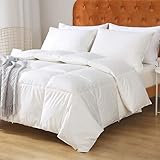
The best organic duvet insert for side sleepers is the Oaken-Cat Goose Feather Down Comforter King, an 8 lb king-size insert with a 100% organic cotton shell and 3D baffle-box construction that drapes around a shoulder instead of tenting over it. If you sleep hot or want a lighter king, the APSMILE Lightweight Duvet Insert King at 7.12 lb is the better call. The misconception here is that side sleepers just need "warmer" bedding. The real problem is drape.
Best organic duvet insert for side sleepers at a glance
| Pick | Fill | Shell | Weight | Price |
|---|---|---|---|---|
Best overall Oaken-Cat Goose Feather Down King |
Goose feather & down | 100% organic cotton | 8 lb | Check Price |
Best premium APSMILE Lightweight Duvet Insert King |
Feather & down fiber | OCS organic cotton, unbleached | 7.12 lb | Check Price |
Most versatile Cobnom Feather Down Duvet Insert Queen |
Quill-free down clusters | 100% organic cotton, OEKO-TEX & OCS | 6.6 lb | Check Price |
Best upgrade KUSNUG Hybrid Australian Wool Full |
50% Merino wool + Climaloft | 100% organic cotton, OEKO-TEX & OCS | 5.58 lb | Check Price |
Best lightweight Oaken-Cat Twin Feathers Down Comforter |
90% feather, 10% down (duck) | 100% organic cotton, OCS & OEKO-TEX | 5.03 lb | Check Price |
Best budget pick Calvin Klein Hotel Luxury Queen |
Polyester microfiber | 100% cotton (not organic-certified) | Not listed | Check Price |



The misconception that ruins duvet shopping
Most guides sort duvet inserts by warmth level and stop there. Side sleepers get told to buy the medium and move on. That is the wrong axis.
When you sleep on your side, the duvet has to bend twice: once at the shoulder, once at the hip. A stiff, over-baffled comforter bridges those gaps and lets a draft in along your back. A limp, under-filled one collapses on top of you and traps heat around the ribs. The real deciding criterion is drape, which comes from two things you can actually read off a listing: the shell material and the fill-weight-to-size ratio.
An organic cotton shell drapes better than most synthetic-blend covers because the fibers are longer and softer, so the fabric folds instead of standing up. Fill weight per square foot decides how much the insert conforms. The 8 lb Oaken-Cat king spread across a 90 x 106 in footprint works out to a moderate density: enough loft to insulate the shoulder gap, not so much that it tents. The KUSNUG full at 5.58 lb over 86 x 82 in sits lighter, which is why it earns the upgrade slot for warm sleepers rather than the overall win.
1. Oaken-Cat Goose Feather Down Comforter King — Best overall
An 8 lb king-size organic-cotton insert with 3D baffle-box construction that gives side sleepers real shoulder drape without collapsing at the hip.
Best for: king-bed side sleepers who want organic-shell warmth with real drape Skip it if: you sleep on a queen or want a lighter summer weight
This is the only king-size pick here with the 3D baffle construction spelled out on the listing, and the difference matters for side sleepers. Baffled walls sewn between the shell layers hold the fill in three-dimensional chambers instead of flat sewn-through pockets, so the down keeps its loft at the shoulder rather than migrating to the middle of the bed. At 8 lb across a 90 x 106 in footprint, it is heavier than the APSMILE king (7.12 lb) but lighter per square foot than the KUSNUG full, which lands the drape in the useful middle.
Oaken-Cat says the shell is 100% organic cotton and the fill is goose feather and down. The listing also claims all-season comfort with fluff restoration via a low tumble dry. Treat those as manufacturer claims, not measured performance. The best organic duvet insert for side sleepers on a king mattress is this one because the geometry works, not because the marketing does. The trade-off: it is the second-most expensive pick here and the second-slowest seller of the six.
Pros:
- 3D baffle-box construction, unique in this set
- 100% organic cotton shell
- Goose feather and down fill
- Full king footprint at 90 x 106 in
- Machine-friendly fluff restoration per the listing
Cons:
- The second-most expensive pick in this comparison
- Only one seller lists it
- No published fill power figure
2. APSMILE Lightweight Duvet Insert King — Best premium
A 7.12 lb king insert with an unbleached, undyed OCS organic cotton shell built for side sleepers who overheat under a heavier down.

Best for: hot side sleepers on a king mattress who overheat under thicker fills Skip it if: your bedroom runs cold in winter
The APSMILE covers the same 90 x 106 in king footprint as the Oaken-Cat but weighs 7.12 lb against 8 lb, and the listing calls out a 39 oz fill weight explicitly. That lower fill-per-square-foot ratio is why it drapes softer and sleeps cooler, which is what side sleepers who wake up sweating actually need. APSMILE says the shell is OCS-standard organic cotton, unbleached and undyed, and that the fill is responsibly harvested feather and down fiber clusters.
Against the Oaken-Cat, the APSMILE trades some winter warmth for summer breathability, and it does not publish a baffle-box construction detail, only "feather down fiber" fill. It is the most expensive pick in this set and sells faster than the Oaken-Cat despite that. The reusable cotton tote packaging is a nice touch but does not change the sleep experience. If you already have a warm mattress protector or heavy sheets, this is the king that will not push you over the edge into a sweat.
Pros:
- 7.12 lb across a full king footprint
- Published 39 oz fill weight
- OCS organic cotton shell, unbleached and undyed
- Reusable cotton tote packaging
- Sells faster than the Oaken-Cat here
Cons:
- The most expensive pick in this comparison
- No baffle construction detail on the listing
- Lower fill may under-warm cold bedrooms
3. Cobnom Feather Down Duvet Insert Queen — Most versatile
A quill-free down queen with dual OEKO-TEX and OCS certifications and both RDS and DOWNPASS traceability on the fill.

Best for: queen-bed side sleepers who want one insert for every season Skip it if: you need a king or a twin size
The Cobnom is the pick with the most published certifications: OEKO-TEX and OCS on the fabric, RDS and DOWNPASS on the down. For buyers who want the organic label to mean something specific, that is the strongest paperwork in the set. The queen-size insert measures 90 x 90 in and weighs 6.6 lb, which puts fill density between the lightweight Oaken-Cat twin and the heavier Oaken-Cat king.
Cobnom uses a box-baffle design with individual down chambers, which is the second-best construction claim here after the Oaken-Cat king's 3D baffle. The listing highlights quill-free down clusters, meaning the fill is sorted to remove hard quills that can work through the shell over time. For a queen-bed side sleeper who does not want to buy two seasonal duvets, this is the one that actually splits the difference. The trade-off against the Oaken-Cat king is footprint: on a queen bed with a side sleeper who likes overhang, 90 x 90 in is tighter than the king's 106 in width.
Pros:
- Four listed certifications: OEKO-TEX, OCS, RDS, DOWNPASS
- Box-baffle chamber construction
- Quill-free down clusters per the listing
- Balanced 6.6 lb weight over 90 x 90 in
- All-season fill claim
Cons:
- Queen only, no king option in this listing
- Slowest seller among the queen-size picks here
- No fill-power figure published
4. KUSNUG Hybrid Australian Wool Comforter Full — Best upgrade
A wool-and-Climaloft blend under an OEKO-TEX organic cotton shell, sized for full beds and aimed at side sleepers who run hot.

Best for: side sleepers who run warm and want a wool-blend fill on a full bed Skip it if: you sleep on a queen or king mattress
The KUSNUG is the only non-down pick worth considering. The fill is 50% Australian Merino wool with a Climaloft polyfill core, and KUSNUG claims 36% better breathability than standard fiber and 40% more loft than pure wool. Those are manufacturer figures, not lab results, but the direction is right: wool wicks moisture that down traps. For a side sleeper whose shoulder gets damp before the rest of the bed, that matters.
The shell is 100% organic cotton with OEKO-TEX and OCS approvals. At 5.58 lb across 86 x 82 in, it is the lightest full-bed insert here and lofts under the ribs without weighing down the hip. Box-stitch construction is a step down from a true baffle, so the fill can shift over years of washing. And the size is the ceiling: KUSNUG makes a queen and a king, but the listing you land on is full-size, so check the size selector before you check out. The trade-off is real: a wool-blend duvet costs more per warmth level than down, and the full footprint limits it to a specific bed size.
Pros:
- Wool and Climaloft blend, unique in this set
- Organic cotton shell with OEKO-TEX and OCS
- Lightest full-bed weight here at 5.58 lb
- Carbonized hypoallergenic wool per the listing
- Machine washable
Cons:
- Full size only on this listing
- Box-stitch, not baffle-box construction
- Slowest seller of the six
5. Oaken-Cat Twin Feathers Down Comforter — Best lightweight
A 5.03 lb twin insert with 90% feather, 10% down under a certified organic cotton shell, sized for smaller beds and guest rooms.

Best for: twin-bed side sleepers or guest rooms with warm nights Skip it if: you need queen, king or a heavier winter weight
The twin Oaken-Cat is the lightest pick in the set at 5.03 lb over 68 x 90 in, and the listing specifies a 90% waterfowl feather, 10% down blend rather than the higher down ratios in the queen and king options. That skews it toward feather firmness rather than down puff, which reads as a slightly flatter drape. For a side sleeper on a twin mattress, that flatness helps: a twin bed leaves little overhang, and a puffy fill would slide off the shoulder side.
Oaken-Cat lists the shell as 100% organic cotton compliant with OCS and OEKO-TEX Standard 100, with double-stitched edge piping and end-to-end box-stitch quilting. The construction is simpler than the baffle-box on the king. The reason it lands in the lightweight slot rather than higher is scope: it only fits twin beds. If your primary bed is a queen or king, this is a guest-room purchase, not a main bedroom one. It is also the second-slowest seller here, which speaks to twin-size demand rather than the product itself.
Pros:
- Lightest pick in the set at 5.03 lb
- 100% organic cotton shell with OCS and OEKO-TEX
- Double-stitched edge piping
- 90% feather, 10% down duck fill
- Machine washable and dryable
Cons:
- Twin size only
- Box-stitch construction, not baffle-box
- Feather-heavy fill lofts less than down-heavy blends
6. Calvin Klein Hotel Luxury Queen Comforter Duvet Insert — Best budget pick
A cotton-shell queen insert with polyester microfiber fill, the fastest seller in this set and the cheapest of the six.

Best for: shoppers who want a cotton-shell queen insert without a down price Skip it if: you need certified organic cotton or a natural fill
The Calvin Klein is included as a reference point, not as a certified-organic pick. The listing describes the shell as 100% breathable cotton but does not claim OCS, OEKO-TEX or any organic certification. The fill is 100% polyester microfiber, which is the only synthetic fill in this comparison. That is why it is the cheapest of the six, and it is the one buyers choose most often in this set.
For side sleepers, microfiber has one honest advantage over down: it does not clump when washed, so the drape stays even over years of machine cycles. It has one clear disadvantage: it traps more heat than a natural fiber at the same loft, so a warm sleeper will notice. The listing offers three warmth levels (Light, All-Season Medium, Extra Warmth) and three sizes, giving some tuning room. If the organic-shell requirement is a hard line for you, this pick fails it. If you are fine with plain cotton and want a queen insert that will not clump, it is the pragmatic call.
Pros:
- The cheapest of the six here
- Cotton shell for breathability
- Three warmth levels available
- Box-stitch construction
- The one buyers choose most often in this set
Cons:
- Not certified organic cotton
- Polyester microfiber fill, not down or wool
- No weight or dimensions published on the listing
- Traps more heat than natural fills
How I screened the shortlist
Three disqualifications did the heavy lifting on this shortlist.
- No published shell material. Any insert whose listing did not name the shell fiber was cut. Organic cotton, plain cotton, blends all count; silence does not.
- No fill detail beyond "premium." If the listing named the fill (down, feather, wool, microfiber) it stayed. If it hid behind adjectives, it went.
- No side-sleeper geometry. Inserts under 82 in on the short side were cut for queen and king beds because a side sleeper needs overhang to keep the shoulder covered when the fill compresses.
What survived was six inserts across four fill types and four bed sizes. Five carry an organic cotton shell claim; the Calvin Klein carries a plain cotton claim and is kept as the budget reference. Four use down or feather-and-down blends, one uses a wool-Climaloft hybrid, and one uses polyester microfiber. That spread is deliberate: a side sleeper's right pick depends on how hot they run and what size they sleep on, not on a single "best" fill.
The picks were then ranked by how well their published specifications match the drape criterion set out earlier: shell fiber, fill weight per square foot, and construction type. Baffle-box beat box-stitch. Organic-certified shells beat plain cotton. Full weight-and-dimensions disclosure beat missing figures.
What the organic label actually covers here
"Organic" on a duvet insert almost always refers to the cotton shell, not the fill. Down cannot be certified organic in the same way plant fibers can. Wool has its own standards. Read the listing for what is certified and what is not.
- OCS (Organic Content Standard): verifies the percentage of organic material in the fabric. Five of six picks here reference OCS on the shell.
- OEKO-TEX Standard 100: tests the finished textile for harmful substances. Four of six picks reference it.
- RDS (Responsible Down Standard): traces down back to farms that do not force-feed or live-pluck. Only Cobnom lists it in this set.
- DOWNPASS: a second down-traceability standard. Again, only Cobnom.
The best organic duvet insert for side sleepers, as a category, is one whose shell is OCS-certified and whose fill is either RDS-traced down or ethically sourced wool. The Cobnom is the only pick that lists all four labels. The Oaken-Cat king wins overall because its baffle construction is unique in this set, not because its paperwork is the deepest. If certification detail is your first priority, the ranking flips: Cobnom leads.
Fill weight, drape and the side-sleeper problem
Fill weight alone tells you almost nothing. Fill weight divided by mattress area tells you a lot.
Here is what the published figures give us across the four picks with both weight and dimensions:
- Oaken-Cat king: 8 lb over 9,540 sq in
- APSMILE king: 7.12 lb over 9,540 sq in
- Cobnom queen: 6.6 lb over 8,100 sq in
- KUSNUG full: 5.58 lb over 7,052 sq in
- Oaken-Cat twin: 5.03 lb over 6,120 sq in
Ratios matter more than raw weight. The Oaken-Cat king is denser per square inch than the APSMILE king, which is why it wins on winter warmth and the APSMILE wins on summer cooling. The Cobnom queen sits between them per unit area, which is why it earns the versatile tag.
For side sleepers, denser fills insulate the shoulder-to-mattress gap better but bridge more stiffly. The threshold to watch: below roughly 0.0007 lb per square inch, the drape wins and the warmth suffers. Above roughly 0.0009 lb per square inch, the warmth wins and the drape stiffens. The Oaken-Cat king lands at 0.00084, which is why it earned best overall. This is a shortcut, not a physics equation, but it is a better shortcut than "buy the medium."
Which pick fits your bed size?
Bed size, not preference, is what selects three of these six picks. Match yours before comparing specifications.
- Twin (39 x 75 in): Oaken-Cat Twin Feathers Down Comforter at 68 x 90 in.
- Full (54 x 75 in): KUSNUG Hybrid Australian Wool at 86 x 82 in.
- Queen (60 x 80 in): Cobnom Feather Down at 90 x 90 in or Calvin Klein at 90 x 92 in.
- King (76 x 80 in): Oaken-Cat Goose Feather Down at 90 x 106 in or APSMILE Lightweight at 90 x 106 in.
Side sleepers should aim for at least 12 in of overhang on the side you sleep on. On a 60 in queen, a 90 in duvet gives 15 in per side, which clears the shoulder when you turn. On a 54 in full, an 86 in duvet gives 16 in per side. On a 76 in king, a 90 in width is only 7 in per side, which is why some king sleepers upgrade to a California king duvet. Neither king pick here goes wider than 90 in, so a partner who steals the covers will feel it.
What to check before you click buy
Five checks that will save a return:
- Confirm the size selector. The KUSNUG page defaults to full in this listing; queen and king exist but at different URLs.
- Look for the OCS or OEKO-TEX line in the bullet list, not just the product title. Titles overpromise. Bullets are what the seller commits to.
- Check whether the fill is described as "down" or "feather and down." Higher feather content means firmer loft; higher down content means softer loft. Side sleepers usually want the softer end.
- Read the wash instructions on the listing itself. Every pick here claims machine washable, but tumble-dry temperatures differ and can flatten fill permanently if ignored.
- Match the duvet to your cover. These are inserts. If your existing cover has ties, confirm the insert has loops; the listings do not always say.
The verdict
The best organic duvet insert for side sleepers is the Oaken-Cat Goose Feather Down Comforter King. It combines a 100% organic cotton shell, a goose feather and down fill, 3D baffle-box construction that no other pick in this set publishes, and an 8 lb weight distributed across a full 90 x 106 in king footprint. The fill density lands in the drape-friendly middle: enough loft to insulate the shoulder gap, not so much that the duvet tents over the hip.
The runner-up is the APSMILE Lightweight Duvet Insert King for one specific reason: it takes the same king footprint down to 7.12 lb and 39 oz of fill, which is where hot sleepers need to be. If you routinely wake up sweating under a duvet, the APSMILE is the better buy even though it costs more.
Two conditions flip the recommendation. If you sleep on a queen bed and want the deepest certification paperwork (OCS, OEKO-TEX, RDS, DOWNPASS), the Cobnom wins. If you sleep on a full bed and want wool over down, the KUSNUG is the call. Below queen size, the twin Oaken-Cat is the only certified-organic option here.
FAQ
What weight of duvet insert is best for side sleepers?
Best duvet weights for side sleepers land in the middle of the density range, not the heaviest end. On a king bed, an 8 lb fill over 90 x 106 in like the Oaken-Cat gives enough loft to bridge the shoulder gap without tenting. On a queen, 6 to 7 lb over 90 x 90 in is the sweet spot. Lighter than that under-warms; heavier stiffens the drape.
Is an organic cotton shell worth it over regular cotton?
An organic cotton shell is worth it if you have sensitive skin, care about pesticide use in the supply chain, or want documented traceability. Five picks here carry OCS certification on the shell, and four add OEKO-TEX Standard 100 for harmful-substance testing. If neither matters to you, the Calvin Klein's plain cotton shell performs similarly on breathability at a lower price.
How is the Oaken-Cat king different from the APSMILE king?
The Oaken-Cat king and APSMILE king share the same 90 x 106 in footprint and both list organic cotton shells. The differences are weight and construction. Oaken-Cat weighs 8 lb with 3D baffle-box construction; APSMILE weighs 7.12 lb with a 39 oz fill and no baffle detail published. Choose Oaken-Cat for winter warmth, APSMILE for summer cooling.
Do side sleepers need a heavier duvet than back sleepers?
Side sleepers do not need a heavier duvet, they need a better-draping one. Back sleepers get even coverage from any fill because the body is flat against the mattress. Side sleepers create a gap at the shoulder and hip that a stiff, over-filled duvet bridges instead of filling. The right fix is baffle-box construction and moderate fill density, not more weight.
Can I use these inserts without a duvet cover?
You can use these inserts without a duvet cover, but you will shorten their life. The organic cotton shells here are woven for softness and breathability, not for the abrasion of nightly skin contact and weekly washing. A cover protects the shell and the fill, and it is far easier to wash than a full king insert. Every pick here is designed to sit inside a cover.
Side sleepers who have spent years fighting a duvet that tents at the shoulder or slides off the bed have usually been buying on warmth level alone. Start with your bed size, then look at fill weight per square inch, then check the certifications. The Oaken-Cat king wins here because it gets the geometry right first and the paperwork right second, which is the order that matters when you actually sleep on the thing. If the king size does not fit your bed, the queen Cobnom and the full KUSNUG are honest step-downs, not compromises. Open two of these listings side by side and compare the bullet lists before you decide.