Best Cedar Raised Garden Beds by Depth and Height

Five raised beds compared on soil depth, footprint and build height, with a clear pick for anyone setting a bed straight onto an existing lawn.

By Victoria ChapmanUpdated 15 min read
On this page
- Best cedar raised garden bed for thick grass at a glance
- What actually decides a cedar raised garden bed?
- How I screened these five and what got cut
- 1. Best Choice Products 8x2ft Outdoor Wooden Raised Garden — Best overall
- 2. SoliWood Raised Garden Bed with Legs — Best budget pick
- 3. Maple99 Cedar Raised Garden Bed with Legs — Best upgrade
- 4. Best Choice Products 48" x 24" x 30" Raised Garden Bed — Most versatile
- 5. EARTH ELEVATED 100% Canadian Cedar Wood Elevated Garden — Best premium
- Can a raised bed really sit on thick grass?
- Ground-level or on legs: which suits your yard?
- What more money buys in this set
- The verdict
- FAQ
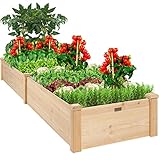
The best cedar raised garden bed for thick grass in this group is the Best Choice Products 8x2ft bed, a 96x24x10in fir frame that covers more lawn in one run than anything else here. If you want to garden standing up instead of kneeling, the SoliWood 48x24x30in cedar bed on legs is the better buy. Quick shortlist: the long ground-level bed for coverage, the SoliWood for height at the lowest price in the set, and the Maple99 for a tight square corner.
Best cedar raised garden bed for thick grass at a glance
| Pick | Soil depth | Footprint | Price |
|---|---|---|---|
| 10in | 96 x 24 in | Check Price | |
Best budget pick SoliWood Raised Garden Bed with Legs |
30in build height | 48 x 24 in | Check Price |
Best upgrade Maple99 Cedar Raised Garden Bed with Legs |
30in build height | 26.5 x 26.5 in | Check Price |
Most versatile Best Choice Products 48" x 24" x 30" Raised Garden Bed |
16in | 48 x 24 in | Check Price |
| 30in build height | 36 x 18 in | Check Price |


What actually decides a cedar raised garden bed?
Most guides for the best cedar raised garden bed for thick grass compare wood species first. Cedar versus fir, Western red versus Chinese. That comparison matters less than you'd think, because every bed here claims rot resistance and none of them publish a treatment or a thickness figure you could check.
Two numbers decide it instead. Soil depth is the first. A 10in ground-level bed and a 16in deep planter grow different crops. Lettuce, bush beans and herbs are happy in 10in. Carrots and beets want the 16in the Best Choice Products elevated planter publishes.
Footprint is the second. The spread here is enormous: 96x24in at one end, 26.5x26.5in at the other. That's the difference between a growing strip along a fence and a single square on a balcony.
Height is a comfort decision, not a growing one. Three of the five beds stand 30in tall. That puts the soil surface near hip level, which is the entire argument for legs.
- Growing shallow-rooted crops: 10in of depth is enough
- Growing root vegetables: look for 16in or more
- Bad back or knees: pick a 30in build height
- Small balcony: measure before you commit to 96in of length
How I screened these five and what got cut
I set three criteria before looking at any listing, weighted in this order.
- Published dimensions, weighted heaviest. A bed you can't measure against your space is a gamble. All five here publish full dimensions in inches.
- A stated planting depth or build height. Two beds publish soil depth directly. The other three publish a 30in overall height for elevated frames, which tells you the working height even when the box depth isn't broken out.
- A named wood. Cedar or fir, stated in the listing rather than implied. Anything describing itself only as "wood" was cut.
Why those three and in that order? Because a raised bed is a container, and containers succeed or fail on fit and volume. A listing that hides its dimensions has usually hidden something else too.
I compared the published specifications side by side across the set. That comparison threw up the one gap worth naming up front: only two of the five publish a load capacity, 200lb for the Maple99 and 300lb claimed for the SoliWood. Soil is heavy. If capacity matters to you, your shortlist is already down to two.
1. Best Choice Products 8x2ft Outdoor Wooden Raised Garden — Best overall
It covers 96in of lawn in a single 20lb frame, which is the most planting area per assembly in this set.
Best for: covering a wide strip of lawn with one long planting run Skip it if: you need waist-height access or root depth beyond 10in
Nothing else here comes close on length. At 96 x 24 x 10in, this bed puts down four times the ground coverage of the Maple99's 26.5in square, and it does it at 20lb, the lightest weight published in the set. That combination is unusual: a big frame that one person can carry to position before filling.
The build is Chinese fir rather than cedar, which is the trade-off. Best Choice Products says the pre-sanded panels use dovetail joints that slide together and lock with screw-fastened posts, and that a liner is included to keep soil off the wood. A middle divider comes in the box, so you can run two 48in sections with different soil mixes if you want tomatoes on one side and herbs on the other.
The 10in depth is the real limit. Lettuce, chard, bush beans and most herbs are fine. Carrots and parsnips are not, and the Best Choice Products 16in elevated planter is the pick if root crops are the point. This is also the only bed here that asks you to kneel.
Pros:
- Longest footprint in the set at 96in
- Lightest published weight at 20lb
- Liner and middle divider included per the listing
- Dovetail joints with screw-fastened posts, per the brand
- Second-cheapest of the five
Cons:
- 10in depth rules out deep root crops
- Fir, not cedar, unlike three others here
- Ground-level, so no relief for knees or back
- Slowest seller of the five in this category
- Only one seller lists it
2. SoliWood Raised Garden Bed with Legs — Best budget pick
It's the cheapest of the five and still a 48x24x30in cedar frame with a claimed 300lb capacity.

Best for: a first elevated bed on a patio or deck at the lowest price here Skip it if: you want natural cedar tone rather than a gray finish
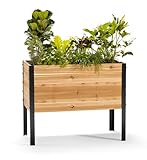
This is the value play in the set and the reason is arithmetic. It's price rank 1, and it still gives you the same 48 x 24in planting area as the Best Choice Products elevated bed at the same 30in height. SoliWood claims a 300lb weight capacity, the highest figure published by any bed here, and 200lb more than the Maple99 states.
It's also the heaviest at 38.9lb, which reads as more material in the frame rather than a drawback. The finish is gray, described as a water-based protective coat over premium cedar. That's a deliberate look and it either suits your deck or it doesn't. If you wanted the honey tone people picture when they hear cedar, the Maple99 and EARTH ELEVATED beds are natural.
SoliWood says drainage holes and a bed liner are included, and that pre-drilled holes make assembly quick. The listing doesn't break out soil depth from the 30in overall height, which is the one number I'd want before planting carrots.
Pros:
- Cheapest pick in the set
- Highest claimed capacity here at 300lb
- Same 48 x 24in planting area as the premium-tier elevated bed
- Cedar with a water-based protective finish, per the listing
- Liner and drainage holes included, per the brand
Cons:
- Gray finish hides the natural cedar grain
- Soil depth is not published separately from the 30in height
- Heaviest bed in the set at 38.9lb
- Only one seller lists it
3. Maple99 Cedar Raised Garden Bed with Legs — Best upgrade
The only pick here with a near-square 26.5 x 26.5in footprint, which makes it the one that fits a tight corner.

Best for: a compact square footprint on a small balcony or corner Skip it if: you want the full 48in planting run the dimensions suggest
Read the numbers carefully on this one. The title mentions 48x24x30, but the published dimensions are 30 x 26.5 x 26.5in, so the footprint is a compact square rather than a long rectangle. Treat 26.5 x 26.5in as what you're buying, and it becomes the smallest-footprint bed in the set by a wide margin.
That's a genuine advantage in the right spot. A 96in bed is useless on a small balcony, and even the 48in frames need a clear four-foot run. This needs just over two feet in each direction.
Maple99 says the cedar carries natural insect-repelling properties and that the frame supports up to 200lb of soil, plants and water without wobble. The brand also notes the elevated design keeps wood out of direct soil contact and cuts weed growth. At 33.3lb it sits in the middle of the weights here, and it's the mid-tier price of the five.
The trade-off against the SoliWood is stark: you pay more for a smaller planting area and a lower stated capacity. You're buying the footprint, not the volume.
Pros:
- Smallest footprint here at 26.5 x 26.5in
- Natural cedar tone rather than a painted finish
- Published 200lb load capacity
- Elevated legs keep the frame out of soil contact, per the brand
- Mid-range price for the set
Cons:
- Title dimensions don't match the published 26.5in square footprint
- Lowest stated capacity of the two beds that publish one
- Least planting area of any pick here
- No published soil depth or model number
- Only one seller lists it
4. Best Choice Products 48" x 24" x 30" Raised Garden Bed — Most versatile
The only bed here that publishes 16in of soil depth at a 30in working height, so root crops and comfort come in the same box.

Best for: carrots, beets and other root crops at standing height Skip it if: cedar specifically is the requirement
Depth is the whole argument. Every other elevated bed here publishes a 30in overall height and leaves you guessing at the box. This one states 16in of soil depth, which is 6in more than the ground-level Best Choice Products bed and enough for the carrots, beets and radishes the brand names.
Best Choice Products describes solid fir with reinforced corner posts and thick panels for wobble-free support, plus built-in drainage to keep soil breathable. At 33lb it's mid-weight for the set, and the acorn brown finish is the only stained colour here.
It's also the one buyers choose most often in this group, and it carries the joint-highest price position. That's a real cost against the SoliWood, which gives you the same 48 x 24in planting area and the same 30in height for the lowest price here. What you're paying for is the published depth figure and the darker finish.
Fir rather than cedar is the other catch. If the word cedar is doing real work in your search, this pick and the 8ft bed both drop out.
Pros:
- Only pick with a published 16in soil depth
- 30in working height reduces bending
- Reinforced corner posts and thick panels, per the brand
- Acorn brown stain, the only finished colour here
- The one buyers choose most often in this set
Cons:
- Fir, not cedar
- Joint-highest price position in the set
- Same planting area as the cheapest pick here
- No published load capacity
- Only one seller lists it
5. EARTH ELEVATED 100% Canadian Cedar Wood Elevated Garden — Best premium
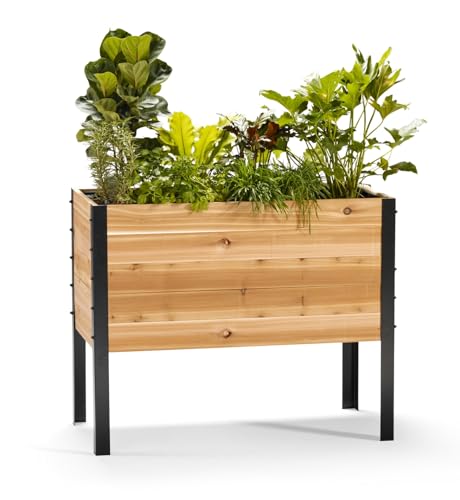
A narrow 36 x 18in body at 30in tall, which is the only pick shaped to sit tight against a wall or railing.
Best for: a narrow herb bed against a wall or railing Skip it if: you need a published weight or capacity figure before buying
Shape is what you're paying for. At 36 x 18in, this is 6in shallower front-to-back than any other bed here, and that 18in dimension is what lets it tuck against a deck rail or a fence without blocking a walkway. Every other elevated pick needs 24in or more of clearance.
EARTH ELEVATED describes 100% Canadian Western red cedar, chosen for rot resistance, with built-in drainage and tools included for assembly. The brand pitches the 30in ergonomic height at gardeners dealing with back discomfort and joint pain, and names rosemary, mint, thyme, parsley and oregano as the intended crops. That herb-scale framing matches the footprint: 36 x 18in is a herb bed, not a vegetable plot.
It's the most expensive pick here and the least documented. No weight, no capacity, no soil depth. It's also the slowest seller of the five alongside the 8ft bed. You're buying the named cedar and the narrow shape, and accepting fewer published numbers than the cheaper beds give you.
Pros:
- Narrowest body here at 18in front-to-back
- Named 100% Canadian Western red cedar
- Built-in drainage and tools included, per the listing
- 30in height aimed at reduced bending
Cons:
- Most expensive pick in the set
- No published weight or load capacity
- No stated soil depth
- Smallest planting area after the Maple99
- Only one seller lists it
Can a raised bed really sit on thick grass?
Here's the honest answer: none of these five listings makes a claim about installing over established turf. Only the 8ft Best Choice Products bed even mentions grass, and that's in the context of decorating a lawn area rather than smothering one. So treat grass suppression as your job, not the bed's.
What the specifications do tell you is which beds give grass the least room to fight back.
- A 10in ground-level bed puts 10in of soil over the turf. That's usually enough to kill grass below it if you block light first.
- A 30in elevated frame on legs never touches the lawn at all, so grass keeps growing underneath and you mow around four posts.
- Footprint decides the work. Smothering a 96 x 24in strip is a bigger job than smothering nothing at all.
Two practical notes. Cardboard or landscape fabric under a ground-level bed blocks light and is the standard approach; the 8ft bed includes a liner, though the brand describes that liner as protecting the wood from soil rather than as a grass barrier. And an elevated bed sidesteps the question completely, which is why three of the five picks here stand 30in tall.
Ground-level or on legs: which suits your yard?
This is the fork in the road for the best cedar raised garden bed for thick grass, and it isn't about wood at all.
Go ground-level if you have open lawn, want the most growing area for the money, and don't mind kneeling. The 8ft bed at 96 x 24in gives you a strip you can plant in rows. It's the cheapest way to a large planting area in this set after the SoliWood, and at 20lb it's easy to position empty.
Go elevated if any of these apply:
- Your back or knees rule out kneeling. Three picks here stand 30in, which puts soil near hip height.
- You're on a patio, deck or balcony. There's no soil to sit on, so legs are the only option.
- You want the grass question to disappear. Legs mean the frame never contacts turf.
- Pests reach ground beds easily. Both Maple99 and Best Choice Products pitch elevation as deterring animals.
The cost of legs is volume. An elevated frame holds less soil than a 96in ground bed, and only the Best Choice Products 16in planter publishes a depth deep enough for carrots. Also weigh the load: filled soil is heavy, and only two beds here state a capacity, at 200lb and 300lb.
What more money buys in this set
Very little, and that's worth knowing before you spend.
At the entry positions you get the SoliWood at 48 x 24 x 30in with a claimed 300lb capacity, and the 8ft ground bed at 96 x 24 x 10in with a liner and divider. Those two cover the largest planting area in the group. The cheapest bed here also has the highest published capacity, which is not the pattern people expect.
Step up to the middle and the Maple99 gives you natural cedar and a 26.5in square footprint. You're paying for a smaller bed with a lower stated capacity than the cheapest pick. That's a footprint purchase, not a capability purchase.
At the top, the Best Choice Products 16in planter adds the only published soil depth deep enough for root crops, which is a genuine capability the cheaper beds don't document. The EARTH ELEVATED bed adds named Canadian Western red cedar and an 18in narrow body, and publishes no weight, no capacity and no depth.
So the money ladder here buys depth, wood species and shape. It does not buy area, and it does not buy documentation.
The verdict
The best cedar raised garden bed for thick grass in this set is the Best Choice Products 8x2ft bed, because at 96 x 24 x 10in it delivers more planting area than anything else here and does it at the second-cheapest price position. Ten inches of soil over turf, with cardboard or fabric underneath, is the standard way people convert a strip of lawn into a growing bed. The included liner and middle divider make it a more finished package than the bare frames.
Two conditions flip that. First, if you can't kneel comfortably, buy the SoliWood instead. Same brand of decision, different body: 48 x 24 x 30in of cedar at the lowest price here, with a claimed 300lb capacity, and no contact with the lawn at all.
Second, if you're growing carrots, beets or parsnips, the 10in depth is a hard stop. The Best Choice Products 16in elevated planter is the only pick in this group that publishes a soil depth deep enough, and it pairs that with a 30in working height.
The runner-up's exact advantage over the winner is height: 30in of standing access versus a bed you garden from your knees. If your back is the deciding factor, that beats 96in of length every time.
FAQ
Is a cedar raised garden bed worth it over fir?
A cedar raised garden bed is worth the step up mainly for the wood's natural insect and rot resistance, which Maple99, SoliWood and EARTH ELEVATED all cite in their listings. But the two fir beds here from Best Choice Products publish the most useful numbers in the set: a 96in length and a 16in soil depth. Buy the specification you need first, then the species.
How much soil depth do vegetables actually need?
Soil depth needs vary by crop. Lettuce, spinach, bush beans and most herbs grow well in the 10in the Best Choice Products 8ft bed provides. Carrots, beets, radishes and parsnips want more, which is why the 16in depth on the elevated Best Choice Products planter matters. It's the only bed here publishing a figure that clears the root-crop threshold.
Which is better, the SoliWood or the Maple99?
Between the SoliWood and the Maple99, the SoliWood wins on almost every published number. It's the cheapest pick here, gives you 48 x 24in of planting area against a 26.5in square, and claims 300lb of capacity to the Maple99's 200lb. Choose the Maple99 only if your space genuinely can't take a four-foot run, or if you want natural cedar rather than gray.
What's the biggest mistake people make buying raised beds?
The biggest mistake is buying on length in the title rather than the published dimensions. The Maple99 title reads 48x24x30, while its listed dimensions are 30 x 26.5 x 26.5in. Measure your space, then check the dimensions field, not the product name. The second mistake is underestimating soil volume: a 96 x 24 x 10in bed takes a lot of filling.
Does an elevated bed stop weeds and grass?
An elevated bed does stop weeds reaching your soil, because the box never touches the ground. Maple99 specifically notes that its raised design minimises weed growth and keeps wood out of soil contact. Grass keeps growing under the legs, though, so you'll still mow around the posts. A ground-level bed needs cardboard or landscape fabric beneath it instead.
Measure your space before you shop anything else, because the footprints here span 96in down to 26.5in and that single number eliminates most of the set for you. If you have open lawn and working knees, the Best Choice Products 8x2ft bed gives you the largest planting run in this group for the second-lowest price, and one person can carry it into position before a single bag of soil goes in. That combination of area, weight and cost is the reason it leads. Lay cardboard first, fill it, and plant in rows.